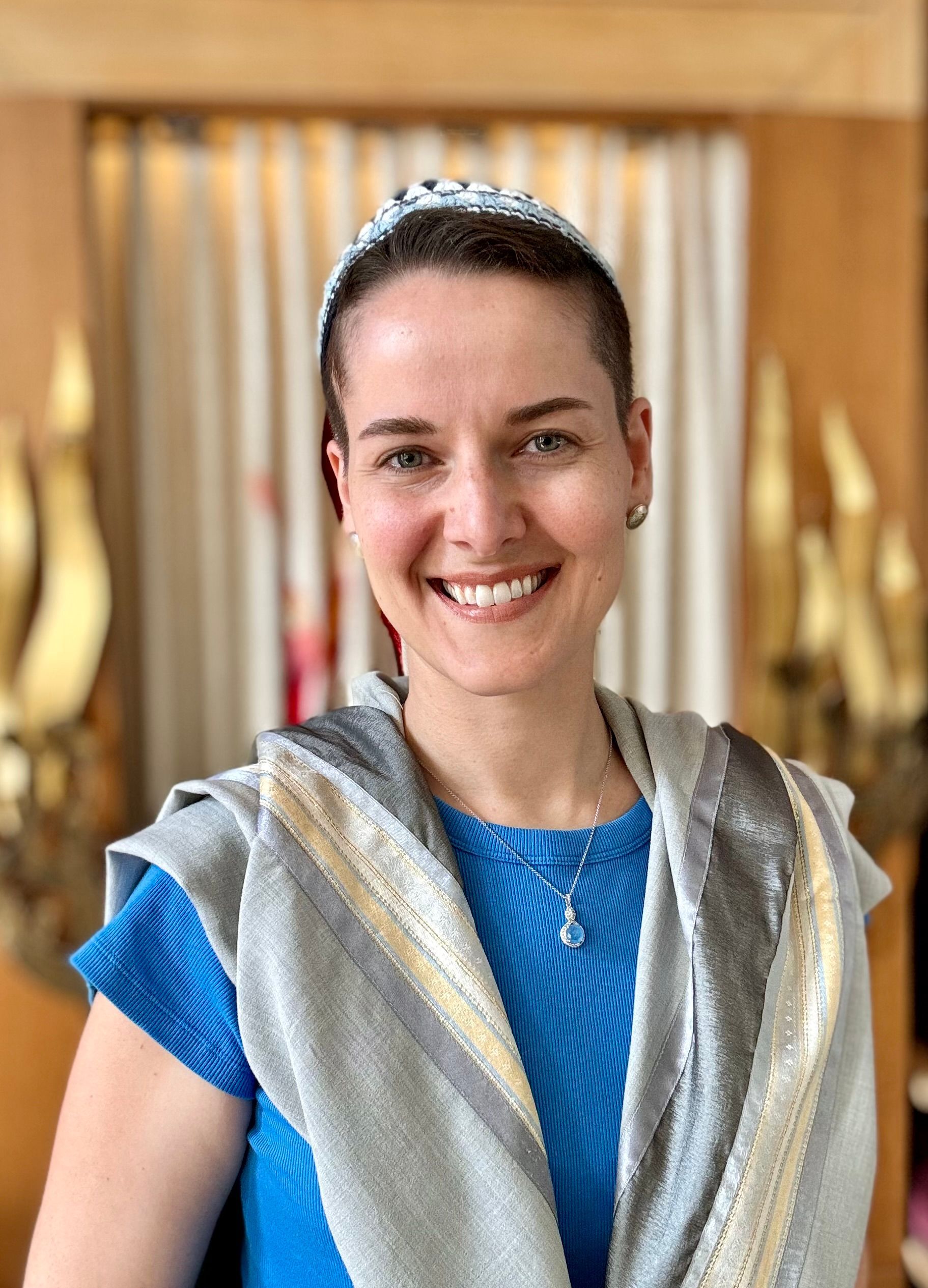
A headshot of Rabbi Simmons-Blumenfeld

Rabbi Rachel Simmons-Blumenfeld

(they/them)


How to Contact Rabbi Simmons-Blumenfeld:

By phone - (207) 774-2649

By email - rabbisimmons@tbemaine.org

By Phone - (207) 774-2649

By email - rabbisimmons@tbemaine.org

Rabbi Rachel A. Simmons-Blumenfeld was ordained at the Ziegler School of Rabbinic Studies in Los Angeles, California, in spring 2022. From graduation until June 2025, they served as the associate rabbi of Congregation Har Shalom in Potomac, Maryland. As of July 2025, they serve as rabbi of Temple Beth El. 


Originally hailing from Alexandria, Virginia, Rabbi Simmons-Blumenfeld completed their undergraduate studies in 2009 with a distinction of magna cum laude from the College of William and Mary in Williamsburg, Virginia, with a dual degree in linguistics and German studies. Following the completion of their BA, they spent several years of her living abroad in Germany, Austria, Costa Rica, and Israel. They speak German and Spanish, play guitar and piano, and prior to entering seminary, they worked as a preschool teacher at the DC Jewish Community Center.


Rabbi Simmons-Blumenfeld finds great joy in leading prayer, providing pastoral care, and developing personal connections to Jewish rituals. They believe it is crucial to identify core communal values and help each other live by them as an embodiment of the Jewish teaching "And you shall love your neighbor as yourself." (Leviticus 19:18)


In their free time, you can find Rabbi Simmons-Blumenfeld doing yoga, painting, reading sci-fi and fantasy novels, cooking, and hanging out with their husband Ian, their stepdaughter Ayele, and their three rescue cats, Kohelet, Galilee, and Musaf.

Rabbi Simmons-Blumenfeld's Selected Writings

By Rabbi Rachel Simmons-Blumenfeld • October 15, 2026
Sermon given October 10, 2026. If you had three wishes, what would you wish for? When I was a kid and watched the movie Aladdin, I remember playing exactly that game with my siblings. We would imagine we ourselves had found a magical lamp and had three wishes, and could make anything we wanted appear. Of course, some smart aleck always wished for more wishes. But the point of this anecdote is just for us all to ask ourselves-- If we actually had the power to imagine something, and wish for it, and make it appear-- what would we wish for? Similarly, when I worked at the JCC preschool in DC, something I particularly loved was sitting with the kids in aftercare who would draw picture after picture after picture while waiting for their parents to pick them up. Those kids didn’t just draw pictures of flowers and dogs and rainbows and other things they could see in their everyday lives (though, for the record, there were a lot of rainbows). They also drew fantastical things, using their imaginations-- ponies with wings, giants who squashed evildoers with one footstep, a rainstorm of jelly beans, a castle with dragons in the moat and dessert all day and no bedtimes. Do you still imagine make drawings like that? If not, do you remember how old you were when you stopped drawing pictures like that? If you could make any fiction into a fact, any hope into a certainty-- what would that hope be? And now that you’re asking yourself these questions, how does the process of dreaming, and imagining, make you feel? Is it exciting? Does it make you feel optimistic? Or-- on the flipside-- does it hurt? Is there a voice in your head that speaks up and says “that’s not real, that can’t happen”? I have a chevruta, a rabbi I study with regularly. This week, we learned a text that addressed the power of imagination. Specifically, we are reading Kitvei HaRambam on Midot v’daot, on conduct and character, in which the Rambam analyzes neurofunctions and the various mental faculties we humans have, centuries before modern medicine provided empirical data on the subject. He makes distinctions between rational, sensory, and other mental faculties, and then reflects on the power of imagination. Now, it is clear that Maimonides has some personal experience with the fantastical, with imagining things that he didn’t actually see with his own eyes. We know this because he lists some of the things he has imagined for us, things like: A person who is gigantic, so tall that their head reaches into the clouds; Or a monster with a head so big it has space for a thousand eyes; Maimonides then says: “The imaginative part of the soul is the faculty that remembers the impressions of the senses after they disappear from the senses that perceived them… and this imaginative faculty assembles those remembered impressions or separates them." However, Maimonides’ experiences with his imagination did not lead him to conclude that the things he imagines are actually possible or realistic. Instead, he concluded: “The imaginative faculty combines from the impressions it perceived things that it did not perceive at all-- even things that are impossible to perceive.” In fact, the Rambam goes even further to name as ridiculous anybody who believe “that whatever can be imagined is possible to exist.” That is to say, Maimonides believed that just because we can imagine something does not mean that it can actually come to pass. And though this sounds kind of pessimistic to me, I’m guessing many of us have also had similar moments in our lives where we have also felt like what Maimonides is describing. If I pivot to the slightly more serious things that I dream about, things like sustainable peace in the Middle East…. Sometimes, when life seems overwhelming or a lot of things in the news are going badly, it can feel like our dreams, and the things we hope for or imagine might one day come to pass, are truly unrealistic in this world. It can feel like they’re just ideas or fantasies with no hope of actually becoming reality. I’m not talking about dragons or elves (though who knows what scientists could clone or whip up in a lab, or what exists on other planets in the universe-- we can’t guarantee that there aren’t dragons somewhere!). I’m talking about the things I ache for-- Things like a world where hunger and poverty do not run rampant. Things like a world where we can look our children in the eye at KBE and tell them that they will never, ever be attacked or excluded just for being Jewish. Can that ever really come to pass? I try, and I know that we all do, to work for a world where these things can be true. But sometimes, that feels really, really unlikely, and really, really far off. Sometimes, it feels like Maimonides is right-- like just because we can imagine something like true peace, just because we can imagine that safety, doesn’t mean it’s actually possible or feasible or realistic. And milestones like another anniversary of October 7th, just a few days ago, drive that hard reality home-- the reality that here, today, the world as it is is still far, far off from the one we are hoping for. The things we long for have not yet come to pass. IF they one day come to pass, there is a good chance that it will not happen in our lifetimes, or in our kids’ lifetimes. There is a concept, in Judaism, called “Moshiach”-- something that is our ultimate dream, something that only exists in an imagined future. Often, we translate the word “Moshiach” as “messiah”, but if we translate it this way, that might bring to mind the Christian definition of the concept, or the idea that there is-- or already was-- one literal person who will bring about a final, incredible, better future. However, a more fitting Jewish translation for the word Moshiach is an imagined future “Redemption”. If we translate Moshiach as “Redemption”, this allows for the possibility that Moshiach is not a single individual we are imagining or dreaming about but rather a widespread shift towards a more just, fair, honest, and peaceful world. This reframing allows Moshiach to become a process, not a person-- and a process each and every one of us can literally help bring about. If Moshiach is a process that we are dreaming about, that means that every action we take has the potential to be part of Moshiach. We can each have ownership in it. The idea of “Moshiach” is rampant in our sacred literature and liturgy. It is clear that our sages, for any skepticism they may have had about dreams and imagination, certainly spent a lot of time dreaming themselves, and imagining their own versions of a better world. Maimonides, who as we just said was a bit skeptical of the power of our dreams to become real, deems in his Mishneh Torah that Moshiach will actually just be a title that a leader will earn who finally rebuilds the Temple. However, the Rambam does allow himself to dream a little, saying that in the time of Moshiach, there will be “no famine, no wars, no envy, no competition.” Another example from our tradition of the discussion of Moshiach comes in Mishneh Sanhedrin, where Rabbi Yohanan claims that the age of Moshiach will come either when all humans are innocent-- or when all humans are guilty . An interesting thought-- We humans get to choose which one it will be! And our Sages taught in the Midrash of Pesikta Rabbasi, “What is the light Israel is waiting for? Israel is waiting for the light of Moshiach.” The Rabbis in the Talmud discuss Moshiach. The prophets in the TaNaKh discuss Moshiach. Isaiah famously imagines the lion lying down with the lamb. And perhaps more audaciously, Isaiah also imagines that there will come a time when humans will never again learn war. We can read the news any day and see that that dream has not yet become reality. Survivors of concentration camps offered testimony of the dreams that they held on to that helped them make it through the horrors of the Shoah. Hostages held in captivity in Gaza described how holding on to shreds of hope and imagining reuniting with their loved ones, hugging them again, helped them retain their sanity and their humanity when their captors attempted to rob them of both. This is all to say that dreaming-- imagining-- and hoping-- is both a daily human activity, and a theoretical or philosophical activity-- but it is also, actually, a key to survival, for us as individuals and as a people. If we don’t dream, we guarantee that these things will never come to pass. And so, we have to keep dreaming. We have to keep imagining. Which brings us back to this room, today, and to us. Are we more like the Rambam in the text I’m studying, believing that we can imagine something but that just because we imagine it doesn’t mean it’s possible? Or do we believe that if we can imagine something -- like actual, true, sustainable peace-- like Moshiach-- or like a world where there is truly dignity and safety for all-- or like a world where hatred of other groups because of who they are no longer happens-- that it could actually, really, one day come to pass? Abraham and Sarah had a dream of family and welcome, even in their old age. Moses and Aaron had a dream of freedom and faith after generations of slavery. Jacob and Esau dreamed of the bonds of healthy, supportive brotherhood after a lifetime of betrayal and estrangement. God had a dream that was realized in this week’s Torah portion-- a dream of creation of this world, of humanity, of relationship. And against all odds, these dreams were, indeed, realized. What if our dreams can be realized too? What if the Rambam was wrong? And the cool thing is, thanks to what I learned this week-- we actually know he was wrong, at least on one account. Because in his description of fantastical, otherworldly things that could never REALLY exist, Maimonides actually offers more examples than the ones I offered at the beginning of this sermon. Remember, he talked about a gigantic man, and about a beast with a thousand eyes. But he actually mentioned something else, as an impossible thing that he could imagine but that could never become reality. He imagines-- quote-- “An iron boat gliding through the air.” …..does that sound familiar? Of course it does! He’s describing an airplane. An iron boat gliding through the air. Because of course, 800 years ago, such a thing seemed literally out of this world. It seemed impossible. But not today. Not anymore. What seemed like a pure dream to our ancestors is, now our reality. So who’s to say that 800 years from now, there might actually be a chance for what we are dreaming of-- a chance at real peace? And who’s to say that the efforts we put in now, even if they won’t bring about that sustained peace we dream of in our lifetime, aren’t planting the seeds for our children’s children’s children to know peace? To actually be a step closer to moshiach ? I’ll ask us all again, as we begin another year together, as we start again with Bereishit-- if you found a lamp, and if you had three wishes, or even if you had ONE wish…what would you wish for-- and what would you do to help make it reality? Shabbat shalom.
By Rabbi Rachel Simmons-Blumenfeld • September 24, 2026
Sermon given on Yom Kippur, September 21, 2026. On Erev Rosh Hashanah this year, we marked the 25th anniversary of the September 11th attacks, and honored the memories of those whose lives were lost on that fateful day. I know that this particular anniversary has brought back personal memories for many of us. I will briefly share that on September 11, 2001, I was a week and a half shy of 14 years old, in English class in the library of my high school. As did many of us, I watched the entire attack play out live on the television. I remember my teacher saying “it’s Bin Laden”, and having no idea who she was talking about. None of us knew when that day began that we would remember it forever— but here it is, two and a half decades later, seared in our minds. We now divide our memories into “before” and “after” that fateful day, and we understand, in retrospect, that a season of change was upon us, as a country and as a world. I also remember where I was when I found out about October 7th. I remember exactly where I was standing in the sanctuary at Har Shalom, the synagogue in Maryland where I served before coming to Temple Beth El. It was the middle of services. I remember which congregant came up to me and whispered the news to me, and I remember the shock, disbelief, and tears that rippled through the room. That day, too, is seared in all of our minds, and many of us also think of our Jewish experiences as being “before” and “after” that date. Those attacks, like Sept. 11, also ushered in a season of change– and it is one we are still in the throes of, as a community and a world. There are other moments that I know are carried in the memories of various people in this room and online– the day the Challenger exploded– the day JFK was murdered– the day the Berlin Wall fell– and more. And beyond the major news events, there are also the personal moments that stay with us forever, and that brought in personal seasons of change; like the day we met our spouse. The day our children came into our lives. The day we got our first cell phone, our first computer, our first car, our first house. Our first Covid vaccine. The day we lost a loved one. The day we received a diagnosis that changed us profoundly. And frequently, these defining moments-- often ushering in the most beautiful or the most painful transitions of our lives-- come unannounced and unexpected. We may not even realize that we have entered a season of change until it is well underway. In such situations, we don’t get to decide exactly how the transition happens. All we get to decide is which values are going to guide us as we rise to meet it. An example of such a life-changing, world-altering moment, and the values with which one of our ancestors rose to meet that moment, sets the stage for the Torah portion we read every Yom Kippur. The story we just read begins in the immediate aftermath of the death of Aaron’s eldest sons and Moses’ nephews, Nadav and Avihu. These two made a fatal choice: to approach God in a strange way, in defiance of the rules and regulations set forth by Moses. And in response to their choice, they are killed on the spot. We did not read about their deaths today, on Yom Kippur– we only read about what happens “acharei mot”, in the immediate aftermath of the tragedy. That means that with the very first words of our Yom Kippur Torah reading- וַיְדַבֵּ֤ר יְהֹוָה֙ אֶל־מֹשֶׁ֔ה אַחֲרֵ֣י מ֔וֹת שְׁנֵ֖י בְּנֵ֣י אַהֲרֹ֑ן And God spoke to Moses after the death of two of Aaron’s sons – we are thrown into the thick of that defining, anguished moment. It’s a dramatic way to start a Torah reading. As fellow humans, we can imagine how this horrific loss would have impacted Aaron, whose sons were abruptly taken from him. No matter whether the sons acted with good or ill intent, no matter if God had decreed their deaths or not, our hearts ache for Aaron as a father. I am certain that for the rest of his life, Aaron remembered the moment he learned that his sons were gone. For him, that would have been the kind of moment that was seared into his memory, like the moments we discussed at the beginning of this sermon. His grief must have been beyond words– which may be why the Torah reports that following his sons’ deaths, וַיִּדֹּ֖ם אַהֲרֹֽן Aaron was silent. Thousands of years later, we as his descendants don’t get to know what was going through his head. We don’t get to know what was going on in his heart. But what we DO get to witness is Aaron’s actions immediately following his sons’ deaths– and those actions teach us a lot about Aaron’s own deepest values, and how those values did not abandon him in his life’s most painful chapter. Because although he is experiencing grief and shock and confusion, his actions are still the actions of a person who draws great meaning from being a priest and a public leader, of a person who draws strength from being steeped in ritual, and from being responsible for others. Even when the emotional rug was pulled out from under him with his son’s deaths, several important things stayed the same for Aaron: he still had his responsibilities; he still had his faith; and he still had his community. And so, as we read today, Aaron cleansed and dressed himself. Then, he carefully selected and offered a bull as a sacrifice to atone for the sins of his family; and finally, he performed the intense, intimate scapegoat ritual on behalf of his family and the entire camp. We can imagine Aaron putting his hands on the head of the condemned goat, feeling its heartbeat, its pulse, and being keenly aware that it would soon join his sons in death, as he confesses aloud his sins and the sins of his sons and the sins of the camp. Because according to our Torah, that’s precisely what he did. Aaron found refuge and relief in our tradition and rituals, and that helped him get through what was probably the most painful and challenging season of change in his life. Aaron is our teacher, today. He is our teacher, not because of his piety or observance level, but because he knew who he was, deep down. He knew what were the core parts of his identity, and he turned to them to help him get through a significant transition. He doubled down on the core essence of who he was– a man of God, a man of ritual, and a man of the people. Knowing who he was, deep down, is what saw him through into the new chapter. As humans, our brains have a remarkable way of learning to cope with change, and of rolling with the punches that life throws us. We integrate new information into our personal narrative on a never-ending basis, modifying and augmenting our concept of “normal” so that we can not only survive, but adapt to new circumstances and fold them into our identities. This cognitive process is called “Assimilation”. Balancing necessary assimilation with staying true to our core values, as Aaron did following the deaths of his sons, is a tricky but necessary balancing act in a world that often throws us curveballs. And as Jews, this is a balancing act that our people has honed into a real talent over the millennia. Throughout the thousands of years of complicated history, we have experienced many significant changes that required both assimilation of new circumstances AND a reaffirmation of our core identities. We had to assimilate major changes, like the exodus from Egypt, the construction– and then the destruction– of the Temples, the Exile from Eretz Yisrael, The Crusades and the Inquisition, the Holocaust, the establishment of the modern State of Israel, October 7th-- just to name a few-- And just like Aaron after his son’s deaths, what has sustained us through all of it is a commitment to our core values and to who we really are– a people at once ancient and brand-new; a people that sanctifies time and space, wherever we go; and a people who know that we are stronger, together. In order to successfully assimilate these dramatic changes into our people’s narrative, we Jews have integrated them into our ritual observances over the generations. Holidays like Hanukkah, Tisha B’av, and Yom HaAtzmaut joined biblical chaggim like Rosh Hashanah and Yom Kippur on the calendar. Inclusive rituals such as bat and brit mitzvahs and weddings for all genders folded smoothly into our practices alongside earlier, less inclusive rituals. The ever-evolving seder plate now has space for oranges and tomatoes next to the matzoh. In other words, we knew who we were . We adapted– AND, we also stayed true to our core sense of self. Because we are Jews! And because that is what Jews do, and what Jews have always done, as far back as Aaron and right up until today, right here at TBE. Because here at TBE, we have also had to assimilate lots of changes over the course of the last 79 years. When this synagogue was founded in the late 1940s, a group of Jewish families from Portland came together to create a non-Orthodox community that would support Jews living in a new, post- Holocaust reality. This group made decisions democratically, taking votes on all kinds of things, from the synagogue’s name to our formal denomination identity. TBE’s first spiritual leader, Rabbi Ephraim Bennett, wrote at TBE’s dedication that “we dedicate not only our Temple but ourselves… our Temple is but the means to enable us to express more clearly our finest aspirations [and] our noblest thoughts.” This lofty moral ambition, combined with the strong sense of egalitarianism, communal responsibility and collective decisions making, planted the seeds for the strong TBE identity that remains the center of who we are today. The founders also clearly named in the very first documents of this synagogue that establishing a religious school and providing for the future of Portland Jews had to be a key and guiding principle of TBE. And since its founding 8 decades ago, TBE has experienced many dramatic moments, and assimilated them into our story: like the Civil Rights Movement; the ordination of women and later non-binary folks as rabbis; communal crises including September 11th and October 7th; the arrival or departure of rabbis and cantors; and significant changes to the building, the grounds, and our various policies. There are people here, in this room today, who clearly remember some of those times of transition for this synagogue, and your continued dedication to the community through it all speaks volumes. TBE will always be grateful to you. We will be grateful to you, because no matter what happened, TBE– the people who are TBE– successfully responded to dramatic change much like our ancestor Aaron did: by doubling down on the core essence of our central values, and who we are– a true community, stronger together than we ever can be separately, committed to helping one another, and committed to stewardship of this Temple for future generations. This core essence of our identity– and this dedication to serving the future of TBE– continue to guide us as we have faced a new season of ongoing change over the past several years. In the past two to three years, the staff and lay leadership of this synagogue has undergone significant shifts, although none as dramatic as Aaron’s loss. But like his loss, these changes have sometimes been sudden, and they have deeply impacted the operations and governance for Temple Beth El. The transitions have been numerous: the exit of a longtime, beloved rabbi; the lengthy processes of finding an interim rabbi and then a new rabbi and then a new executive director; sudden health challenges for team members; and more. All of this has happened, of course, while the world outside of TBE was also experiencing immense upheaval. None of these changes were as traumatic as the ones we named at the start of this sermon. But they were significant, and they upended the status quo. Some of these changes were significant enough that they could have been very damaging to a community that did not know and trust itself. But that’s not what happened. Because we at TBE had a choice of how to respond to these sudden and significant changes, just like Aaron did; and the choice we made, in response to these changes, showed us something truly beautiful about the TBE community. It showed us that, like Aaron, we know who we really are. We showed each other that we WILL step up when it’s important. We WILL we have each others’ backs, including when we disagree. And we WILL act in a way that shows we understand that it’s up to us, at the end of the day, to nurture and bring into being the community we want to see, for ourselves and for our children and for our children’s children . Just as there was no single person who brought TBE into being, 79 years ago, so too there was no single person who decided how TBE would make it through these last few years– in true TBE fashion, it was always a communal effort. Board members showed up for extra meetings and late-night conversations; staff took on extra duties to ensure the office ran as smoothly as possible; so many of you volunteered, showed up, stayed patient, gave feedback, and continued to be generous with your resources, ideas, love, and presence. Everyone stepped up. And because of those communal efforts, now, on the other side of two or three challenging transitional years, as the dust begins to settle, we can all share in feelings of pride for how well this community is doing today. On Erev Rosh Hashanah, I invited us all to look around at each other, and I’d like to invite you to do the same thing right now. Look in front of you, behind you, to your left and right. We are all on the same team, and that team is doing well. TBE is thriving, as it moves into its next chapter, and we all get to be a part of that. TBE is thriving– But don’t take my word for it. Just come to one of our monthly family Shabbats this year, and see for yourself. Come hear the laughter of the kiddos. Come and be SO PROUD of them helping lead services. Come and watch friends old and new kibbitz and sway to the music. Come and make a minyan for your neighbor to say Kaddish. Come and get a hug, or a smile, or just some of Sadie’s famous Mac and Cheese. Come and be in community. Come and meet your family. I know that there are all kinds of studies out there about how interest in organized religion is down in America; about how Jews in particular are affiliating less and less; about how disillusioned many of us feel, and about how despair is settling in where faith and connection used to live. I know that it can feel like hope is hard to come by, nowadays. But when I look out at all of you today, that’s not the story I see, not here at TBE. When I look at all of you, I see a room full of stories, woven into one bigger narrative. I see hundreds of people who are connected by the same ancient, ever-renewing tapestry. I see people whose ancestors came from all over the globe, with nothing but love and hope for us, their descendants. I see a congregation that draws hope and strength from knowing that those who went before us lived through tough times, together, and that we can, too. I see us knowing who we are– a place of audacious welcome and robust diversity of belief– a place where, as we discussed on Rosh Hashanah, we will not hide from difficult conversations. A place where we will be brave, and not cast each other out. A place where we can do teshuvah, and forgive each other, and learn. A place we can be safe. A place we can be home. And, every day, I see us dedicating ourselves, again and again, to the mission of this sacred space, just like Rabbi Bennett called on us to do all of those years ago. In the Torah, we don’t get to know what Aaron was thinking or feeling as he faced one of the most difficult transitions of his life. All we get to know is how he acted, how he channeled his energy, and the legacy he built during a season of immense change. Similarly, our descendants won’t get to know every thought that is going through our brains (though, with Insta and Tik Tok, they’ll know more than perhaps they want to.) But they will get to inherit the communities and institutions we build. They’ll reap the rewards of relationship, and the conflicts, and the strength, and the values and programs that we choose to pour our energy into. And so, we owe it to them, and to ourselves, to be intentional, this year, about who we want to be, together. This Yom Kippur, we can’t promise each other that we will have a good year. We can’t promise each other that we will have an easy year. We don’t know what’s going to happen in the world around us, and we don’t know what sudden changes may happen, that we may have to rise to meet. But what we CAN promise each other is that we will rise and meet whatever this year brings together . We can promise each other that we will rise and meet whatever the coming year brings, anchored by the same values that have been core to TBE from the beginning. Many of you are wearing white today— and several of you have asked me why. In Judaism, white is a color that reminds us of our mortality. On the one hand, white is the color of a burial shroud, the final garment of a Jew, lovingly placed with care onto each of us by a Chevra kadisha. Wearing it reminds us that our time to do good in this world is limited, and that we don’t know how much of it we have. It reminds us of how precious it is to have another chance, another clean slate, if you will, to try, for another year, for another month, for another day, for another hour— to heal any pain we have caused to one another, and to help each other in any way we can. But another reason for us all to wear white on Yom Kippur is because of its beautiful, unifying effect. When we look around us and see our neighbors similarly wrapped in the same color, it reminds us of the gifts and needs and inheritance we have in common , including, specifically, the gift of our community. Mishnah Taanit describes Yom Kippur as a day of repentance and mortality, yes, but also a day of great joy, where unmarried maidens of Jerusalem would wear borrowed white frocks— key word here being borrowed— so that nobody could tell who was richer or poorer or fancier or plainer. That sea of white can be a reminder that, at the end of the day, we are truly in this together, and that when we learn to work through the times when we don’t see eye to eye, we can create and sustain something beyond ourselves, something beautiful, something holy. That is surely what has happened here at TBE. As I considered how I wanted to end this sermon, I read through the book of TBE dedications from 1950, which quoted Rabbi Bennett’s charge to the congregation at the synagogue’s founding. He concluded with the following statement, which I also leave us with today, 79 years later: “I pray that we be granted the strength to fulfill the promise of this hour. May our Temple never fail us; may we never fail it.” Almost eighty years later, Rabbi Bennett, I think we are doing you proud. G’mar Chatima Tova, TBE.
By Rabbi Rachel Simmons-Blumenfeld • September 24, 2026
Sermon given on Kol Nidre, September 20, 2026. Kol Nidre 2026 - Moral Courage In 1944, Nazi forces had conquered wide swaths of Europe and had established large Prisoner-of-War camps for the almost 100,000 Allied forces who were captured by Germany during the fighting. Roddie Edmonds, then 25 years old, was captured and held captive along with hundreds of other Americans in one such camp. He was imprisoned for months, and became a natural leader among the prisoners as the highest-ranking non-commissioned officer held at the camp. The Nazis took note of him and the respect other prisoners gave him. On January 27, 1945, Edmonds was summoned forward by the Nazi officers in charge of the camp. He was commanded to point out which of the American prisoners-of-war were Jewish, and the implications of the deadly order were clear. Edmonds, a Methodist from Tennessee, famously replied: “We are all Jews here.” In 1901, Ho Feng-shan was born in the Hunan province of China. He was diligent and hardworking, and rose in the ranks of the civil service until he achieved the post of consul general in Vienna, Austria in the 1930s, and a doctorate. After Kristallnacht, the Chinese national issued hundreds of visas to Jews to escape to Shanghai. Though his superiors gave him direct orders to stop issuing the visas and threatened him, Dr. Ho refused to cease. In fact, he redoubled his efforts, personally signing thousands of visa permits for Jews fleeing for their lives, earning the ire of the Chinese government and ultimately losing his position and his reputation. In the Netherlands in 1920, an Austrian girl named Hermine was taken in by Dutch foster parents. After finishing high school, she became a secretary at a spice firm, married, and came to be known as “Miep Gies”. After the Nazis took control in the Netherlands, Miep took in and hid her Jewish boss, Otto Frank, and the rest of his family including his daughter Anne for two years while also supporting the organized Dutch Resistance, at direct risk of her own life. And finally, on December 14, 2025, in an attack for which ISIS has since claimed responsibility, two gunmen attacked Jews at Archer Park in Bondi Beach, Australia. Amidst the carnage, incredible footage emerged of an unarmed bystander tackling one of the gunmen to the ground and disarming him, saving Jewish lives while being injured himself in the process. The man’s name was Ahmed al-Ahmed, a 43-year-old Muslim of Syrian descent. He has been hailed as a hero by Jewish institutions around the globe. Rabbi Yehoram Ulman of Bondi Beach described al-Ahmed’s appearance and actions that day as “miraculous” and “holy”. —--- Edmonds, Ho, Gies, and al-Ahmed. These four people were raised in different faiths, different countries, and speaking different languages. They had different habits, different favorite foods, different pet peeves, different hobbies, different levels of education. And yet, when forces beyond their control placed them in extreme, decisive moments, they embodied moral courage, and in doing so, they each saved Jewish lives. Edmonds, Ho, Gies, and al-Ahmed were ordinary people living ordinary lives– and, when it really counted, they acted extraordinarily. I share their stories today not only because it is important to honor and remember those whose bravery has saved Jewish lives, at any time in history, But also because we are yet again living in a time, as Jews, where the joy we want to feel at being Jewish– the celebrations we want to share with friends and family, the pride in our heritage and traditions that we want to wear around our necks or chat openly about with coworkers or post about online– that joy coexists alongside the knowledge that hatred is yet again on the rise, and that our people are yet again one of the targets. Many of us in this room have had to have horrible conversations within our families these last few years– conversations wondering, which of our friends would hide us, if it came to it? Where would we run, if we had to? Who would we trust to protect us? Who would risk their lives to keep us safe, today? That we have had these conversations ourselves, and know how scary it can be, helps us to have a tiny glimpse into the frightening experiences of the Jews who were helped by Edmonds, Ho, Gies, and al-Ahmed. Each of the Jews they rescued, assisted, or saved knew what it was like to ask those questions– and each of them had their answer. Each of them was helped by a non-Jew with absolutely nothing to gain and absolutely everything to lose. Yad Vashem lists 28,707 individuals as formally being “Righteous Among the Nations”, as having knowingly put themselves at direct risk in order to save Jewish lives specifically during the Holocaust. Edmonds, Ho, and Gies are among these thousands of Righteous. Yet the number of Righteous is assuredly far greater in reality. This is for many reasons: in some cases, long-kept secret identities helped protect Jewish children for years after World War 2 had ended. In others, some of the Righteous hid their bravery even from their own families. In others, some of the Righteous eschewed the limelight and declined to be publicly honored or thanked, even by Yad Vashem, because of deep moral and religious convictions. And in some cases, the Righteous themselves were captured, and punished, sometimes with death, for helping Jews– before their heroism could be recorded. It is unlikely that we will ever know the exact number of individuals who defied the Axis powers in order to help our ancestors and other minorities targeted by the Nazis. But what we DO know for certain is that despite the military might of the Nazis; and despite the poisonous propaganda of the Axis powers; there was also, from the beginning, a strong, stubborn, defiantly compassionate undercurrent of moral courage, worldwide , that fought back against the encroaching hatred of Nazism– and that moral courage persisted even after the Shoah had ended. The indefatigable, universal nature of this moral courage is also noteworthy. It defies logic, defies safety, defies ease, defies comfort– and it is strongly connected to a person’s sense of self in relation to all others. Until her death, Miep Gies resisted attention or accolades for her actions in hiding and protecting the Frank family, simply saying, “I am not a hero– I just did what any decent person would have done….. Even an ordinary secretary or a housewife or a teenager can, within their own small ways, turn on a small light in a dark room. ” In broken English, al-Ahmed told Australian press that, quote “My soul asked me to do that… everything in my heart and brain just worked… to manage and to save the people’s life “ Dr. Ho wrote, “I thought it only natural to feel compassion and to want to help. From the standpoint of humanity, that is the way it should be. “ Edmonds, his fellow soldiers testified, was deeply religious and drew strength from the book of Proverbs, often quoting chapter 28, verse 1: “The wicked flee when no man pursues, but the righteous are bold as a lion.” There is a common, brave undercurrent in the words and practices of each of these individuals. Edmonds, Ho, Gies and al-Ahmed each had a conscience that was taught, shaped, and supported for decades by different family, friends, teachers, and religious institutions, as well as different cultural and societal norms. And yet one thing was true for each of them: the combined effects, though widely varied, each reinforced the unshakeable value of all human life. Period. This gave them each the moral tools and reinforcement they needed, in the moment, to be able to respond in a way that saved Jewish life. All four understood that if they wanted to see more goodness in the world, they themselves had to go out and do good. This is a powerful reminder for all of us this Yom Kippur, regardless of whom or what we believe in, regardless of our background. Just as evil is never inevitable– it is taught–so too, moral courage is not accidental. It is also taught, and reinforced, and shaped, and supported– and that means that we can teach it, and reinforce it, and shape it, and support it this year, too. The undercurrent of bravery and moral courage and resistance that inspired and nourished the Righteous Among the Nations is still alive today, still ready to help us, still ready to be welcomed into our hearts. And as Jews, our hearts are primed to welcome that moral courage in. The pain we have suffered as a people has given us the most beautiful superpower, one that can never be taken away: and that superpower is our empathy, and our compassion. We KNOW what it is like to be in bondage; we know what it is like to be scapegoated; we know what it is like to be targeted by powerful governments and propaganda; we know what it is like to have our rights legislated away. Which means we also know it when we see it happening to others– and it means that we know what will happen if we do not make the choice to nurture moral courage in ourselves and our families, starting this Yom Kippur. Just like Edmonds, Ho, Gies, and al-Ahmed, we are ordinary people, living ordinary lives. But just like them, we each– every single one of us– also have the opportunity to love, and to live, in extraordinary ways. Authors of a study on moral courage from the Max Plank and Wuppertal Institutes in Germany concluded that, quote “Our everyday lives might be rich with opportunities for morally courageous behavior when we witness unfairness, harassment, discrimination, bullying, ostracism, dishonesty, corruption, violence, or other… harmful, and norm-violating behavior.” This is certainly true of our world as it is today; we need not look far to find ample opportunities to undertake the work. We can also start small, and practice, and work together. Practicing moral courage can begin at the dinner or kiddush table and with other parents in playground conversations. It starts with considering the jokes and prejudices we tolerate or laugh at and the behaviors we reward and reinforce. Moral courage can look like championing our kids when they stick up for a friend or stand up to a bully and rallying behind our partners when their commitment to ethics means a lost promotion. Practicing moral courage can mean reviewing and rehearsing difficult conversations or scenarios with family about what they wish they could have said or done, if they could go back and do a situation differently. Moral courage might sound like “I’m proud of you for what you said” or “I’ll come along to the protest too” or “I’ve got your back no matter what”. Moral courage means you know you’re not alone in fighting for the value of all human life, and you make sure others know they are not alone, either. Practicing moral courage in public is important, too. Having moral courage can mean speaking up in the supermarket when we hear someone saying something racist, or sexist, or transphobic. It can mean reaching out to our kids’ or grandkids’ schools and offering to come in and talk to their class about antisemitism and our family history. It can mean having difficult yet compassionate conversations with friends over questionable social media posts that make sweeping generalizations. It can mean intentionally utilizing our resources of time, money, and social privilege in ways to further equity. But in addition to all that bravery, there’s something important we can’t lose sight of about moral courage: and that’s the fact that moral courage is also about embracing honesty and joy during uncertain times, like those we are living in now. That means that as Jews, part of having moral courage is also embracing our identities, and living our Jewish lives in a genuine way, never apologizing for being who we are, even when it’s scary or difficult, especially when it’s scary and difficult. Moral courage teaches us that our lives are sacred and our way of being is sacred and doesn’t want us to apologize for being who we are. And moral courage reminds us that our kids are watching us, too, and it asks us to be aware and intentional about what we want them to learn from us about what it means to be a Jew, today. Because the number one thing we can do to ensure our kids love being Jewish and want to be part of Jewish community is for them to see us loving being Jewish and prioritizing being part of Jewish community– not out of guilt, but out of true joy. To see us being brave, and being bravely Jewish, and to see that we believe it is worth it. Not because it is easy, but because it is wonderful. If I could make a wish for all of us this year, it would be this: that we go forward from these High Holidays with hearts resolved to moral courage both inside and outside of these synagogue walls, and with the knowledge that our Jewish community is strong, joyful, and rooting us on. I wish for us to go forth from these High Holidays with the knowledge that if and when we are called on to take a stand and have moral courage this year, we will do so, proudly–and we will be able to call on each other for support. I wish for us all to go forth from these High Holidays with the understanding that we, too, can choose to be extraordinary. That we have what it takes to be Righteous. I’ll leave us with a final thought: Like the book of Esther, this entire sermon is missing a word– God. It’s also missing any quotes or citations from our Torah scrolls. This is intentional and significant. It’s significant because moral courage does not require belief in God– it requires belief in justice and in the preciousness of all human life, but it is available to all of us, regardless of belief. We can all have moral courage. And, it’s significant because, just as our liturgy tomorrow morning will begin with “Mah tovu ohalecha yaakov”-- a line from the Torah, quoting someone who is a non-Jew– sometimes our most important teachers are not Jewish. Sometimes the most important life lessons transcend the bounds of religion or creed. And this is one of those times. My friends: May the actions and the words of Roddie Edmonds, Ho Feng-shan, Miep Gies, Ahmed al-Ahmed and all of the Righteous, accompany us from this place tonight and inspire us and guide us this year. May we be inscribed in the book of Life, and may our Lives be guided this year by moral courage and by Jewish joy. G’mar chatima tova.
By Rabbi Rachel Simmons-Blumenfeld • September 17, 2026
Tkia…. Shevarim…. Do you hear that ? Listen again. Truah….. Do you hear it? That, my friends, is the sound of something missing. It’s the sound of the absence of the shofar, the absence of the unique sound we associate so strongly with Rosh Hashanah and the start of the year, but which we will not hear today, because it is also Shabbat. For those of us who have heard a shofar being blown before, we KNOW that ram’s horn sound. There is nothing like it. We carry the memory of that sound within us. We know what it’s like to stand in a room like this one, or in the hundreds, thousands of other rooms around the world where shofarot will be blown these High Holidays, to stand together and to brace ourselves, and then to have our eardrums, and our bones, and our very kishkas shaken with the ancient power of that almost-otherworldly sound. And so today, when I say, tkia ………………… Our brains, and our hearts, know what should be there. It’s an important life skill for us humans, to be able to identify what is missing. Anthropologically, this helps us keep our young safe, helps us keep track of our families and our belongings, and helps us recognize patterns that can tell us if something is safe or edible or not. But the ability to ask ourselves “what’s missing?”-- and then to find meaning in that absence– is also a specifically Jewish skill. Let me explain. This skill goes back as far as Gan Eden, as the Garden of Eden, when Adam HaRishon, the first human, realizes that he does not have an ezer k’negdo , a partner, the way God’s other creations do. Our tradition teaches that the first human relationship, and the first human family, came from noticing, and addressing, that absence. Generations later, in a world missing centralized religious authority, the Torah teaches that God called to Abraham to address that absence, and ethical monotheism emerged. When the Temple was destroyed 2,000 years ago and our ancestors were expelled from Eretz Yisrael, their easy access to our holiest sites was suddenly gone, missing. But inventive rabbis addressed that absence too, pivoting and establishing instead the localized, synagogue and home-based Jewish rituals that are the major building blocks of the rabbinic Judaism we know and love today. And, then, for thousands of years, our people lived in galut , in exile. For generation after generation, what was missing for Jews was our access to the Land of Israel itself– but in our liturgy and at our seders each year, throughout the Diaspora, our ancestors reaffirmed their sacred connection to the Holy Land, making meaning from the absence of physical connection to Eretz Yisrael. Honoring absences in a Jewish way can also be very personal. Each year, we stand up to say kaddish on a loved one’s yahrzeit, the anniversary of their death, to mark another year of missing them. On Yom Kippur, the absence of food and drink will make the spiritual and physical experience of the holiday personally palpable for all those who are fasting– and for those of us who medically cannot abstain from food and drink, the absence of that fast, of that shared physiological and psychological experience, will be our fast. The list could go on, but you get the point: recognizing when something is missing and then making meaning from it is, in fact, a valuable Jewish practice, and has been for millennia. We even have a long-established practice, as Jews, of reading our texts, identifying what’s missing, and then filling in the blanks ourselves– a practice called Midrash, which I often refer to as rabbinic fan-fiction. And so, now that we have established that searching for what is missing is an important Jewish skill, I’d like us to all put it to use, together. I’m going to share two stories with you– one biblical, one modern– and as you listen to the words, I’d like you to ask yourself, first– what’s missing from this story? And then–together we will ask ourselves, how can we make meaning out of the absences in these stories? The first story is from Genesis, which we just read today: “GOD remembered Sarah just as promised, and GOD did for Sarah what had been announced. Sarah conceived and bore a son to Abraham in his old age, at the set time of which God had spoken. Abraham gave his newborn son, whom Sarah had borne him, the name of Isaac…. The child grew up and was weaned, and Abraham held a great feast on the day that Isaac was weaned. Sarah saw the son whom Hagar the Egyptian had borne to Abraham playing. She said to Abraham, “Cast out that slave-woman and her son, for the son of that slave shall not share in the inheritance with my son Isaac.” The matter distressed Abraham greatly, for it concerned a son of his. But God said to Abraham, “Do not be distressed over the boy or your slave; whatever Sarah tells you, do as she says, for it is through Isaac that offspring shall be continued for you. As for the son of the slave-woman, I will make a nation of him, too, for he is your seed.” Early next morning Abraham took some bread and a skin of water, and gave them to Hagar. He placed them over her shoulder, together with the child, and sent her away. And she wandered about in the wilderness of Beer-sheba. When the water was gone from the skin, she left the child under one of the bushes, and went and sat down at a distance, a bowshot away; for she thought, “Let me not look on as the child dies.” And sitting thus afar, she burst into tears. That’s the first story. Now. What’s MISSING from that story? Think about it for a second. God remembers Sarah, Abraham and Sarah have a son, Sarah says to cast out Hagar and her son, Abraham prays to God and then casts out Hagar and her son, who enter the wilderness and believe they are about to die. What is MISSING from the story we just read is the voice of one of our ancestors being brave enough to speak up and say: this is not right . What is missing from the story is the voice of one of our ancestors being brave enough to say: Hagar and her child are also made in God’s image, should we not love them as ourselves? What is missing from the story is the voice of one of our ancestors being brave enough to say: We are all in this together. But instead of these voices, we see our ancestors saying: cast her out! Cast out her child! And then, we see Abraham and Sarah invoking God as a justification for their dangerous and harmful behavior. That’s the first story, and that is what is missing from it. The second story is a bit different, but our task is the same– to listen for what is missing. Here’s the story: When I lived in Israel, I studied at the CY, the Conservative Yeshiva in Jerusalem, alongside rabbinical students from Hebrew College and JTS in New York. During our year, many of us were involved in various volunteer efforts, both in Jerusalem and farther afield. When the time came for the Palestinian olive harvest, local Jewish organizations put out a call for volunteers to cross the Green Line into the Occupied West Bank and assist the Palestinians who were harvesting. These weren’t large harvesting operations— they were mainly groups of one or two Palestinian families, gathering olives for their own personal use in the coming year. And so, a bunch of us rabbinical students from the CY signed up to help. That meant that for several days, a small group including myself and several others from my rabbinical school, gathered with other volunteers in the pre-dawn hours in Jerusalem, piled into a bus, and headed East. We passed soldiers and civilians, guns and cars, and eventually were let out each time pretty much on the side of the road somewhere in the West Bank, near an olive grove where the Palestinian families waited. The work itself was, honestly, pretty fun. It was hard work, but we got to climb and shake trees, chat, and sing. There was a huge language barrier, but “salaam” and “shalom” can go a long way when you’re working towards a common goal. There was so much laughter. The little Palestinian kids played tag among the trees. For lunch we sat on the ground and ate pita and hummus and fresh olive oil (and it was the best olive oil I have ever eaten in my life!) The young Palestinian men showed us how to wrap scarves around our heads to help us keep cool in the hot sun. But after lunch, it was my turn to be on guard duty. I left the group and walked to the edge of the grove and stood on a large rock looking uphill, scanning the tree line. Because the real reason we were there wasn’t to pick olives, though we were happy to do so. The real reason we were there was to be what organizers call a “protective presence”-- to be there and be visibly Jewish, because these Palestinians’ olive groves directly abutted Jewish settlements in the West Bank, and the settlers, each season, like clockwork, attack the Palestinians as they harvested, burning their olives and sometimes the trees themselves, throwing rocks at the people, forcing the families to flee. Having Americans and Israelis standing guard made such an attack less likely to happen– but not unheard of. In fact, literally the day after my first trip into the West Bank, another student from the CY was part of an olive picking group who was attacked and stoned by settlers, and he came back to the yeshiva with his face bloodied. That was real, and it was scary. But the moment that stayed with me from my first day out in the olive groves wasn’t bloody at all. It was just me, alone, standing on that rock at the edge of the olive grove, scanning the hill next to us, looking, looking, looking– and then, seeing, at the top of the hill, first one, and then two young men, wearing white shirts and khakis, with kippot on their heads and peyas down the sides of their faces, appear, and then disappear, and then appear again, moving closer to us. Menacing us. And it was my job, when I saw the threat, to call back to my friends and the families we were helping, to warn them, to see them hurry to load the olives into their cart, to watch the Palestinian mother grab her child, knowing we were in danger– from Jews. That’s the second story. But the longer I sit with that second story, the longer it feels to me like almost the same story as the tale of Abraham, Sarah, Ishmael, and Hagar. Because Sarah and Abraham decided to cast out Hagar and Ishmael, to remove the individuals who made their lives, and their choices, complicated and painful. And there on the hills outside Nablus, in the West Bank, the Israeli settlers wanted to cast out the Palestinians who were harvesting olives. And frankly, they also wanted to cast out me and my fellow rabbinical students, because our version of Judaism was different from theirs, and they thought ours was illegitimate. Those settlers also wanted to remove the individuals who made their lives, and their choices, complicated and painful. In the story from Genesis, there is a heart-wrenching moment, halfway through, after Abraham speaks to God, where we see Abraham pivot in how he treats Hagar and Ishmael. He stops treating Hagar and Ishmael as one of his camp, as one of “us”, and instead start treating Hagar and Ishmael as outsiders, as “them”, and makes plans to expel them. That same shift happened as I stood guard on the rock in the West Bank. Of course, the settlers clearly saw the Palestinians as “them”, as outsiders-- that’s why the settlers wanted to cast them out of the land. But the settlers also saw me, and the other Jewish volunteers as not being “on the same team”-– as being opponents– and to be honest, we saw them in the same bifurcated, combatant light. Though we had ostensibly all started the day praying to the same God, and saying the same Shema, as the sun rose higher in the sky over the olive grove, we ceased to be “us”, to each other, and instead became, firmly, “them”. This is all to say that what was missing from both stories was not only the voice of empathy and compassion, but also the commitment to seeing past the categories of “us” and “them” that we humans fall into so naturally when we come into conflict with each other. What was missing from both stories was a wholehearted attempt to find a solution, a real solution, that supported the dignity and safety of all involved. That absence of a solution that supports the dignity and safety of all involved is one we unfortunately recognize in abundance from our own world today, as we look around us and see that same absence play out on a local and national and global scale– both abroad, in our spiritual homeland, but also closer to home, as Americans and as American Jews, navigating our many differences and often failing to strike the balance between standing up for our own rights and dignity and standing up for the rights and dignity of those with whom we disagree. I am reminded of the famous teaching of Hillel the Elder– אִם אֵין אֲנִי לִי, מִי לִי. וּכְשֶׁאֲנִי לְעַצְמִי, מָה אֲנִי If I am not for myself, who will be for me? And if I am only for myself, what am I? This tension described by Hillel is ancient, echoing through the story of Abraham, Sarah, Hagar, and Ishmael, and echoing through that moment I experienced in the West Bank. But it is also just as pertinent today, for us, as it was thousands of years ago, as we look around us and see the deep divisions in our world, and realize that we are struggling with the exact same human shortcomings our ancestors had. Because that’s the truth, isn’t it? The messy truth. The truth is that we don’t only get to call Abraham and Sarah our ancestors when they are embodying the characteristics we admire, like deep faith and warmth and hospitality. We also have to own up to the fact that their warmth and hospitality had limits– it certainly did for Hagar and Ishmael– and that their less desirable qualities are also part of our spiritual inheritance. We read about them every year. Just like Abraham and Sarah on that fateful day, we, today, are also torn between the categories of “us” and “them”. This is especially painful to experience when the labels of “us” and “them” when we apply them to other Jews. On the one hand, it is completely natural to want to identify with our fellow Jews, and be proud of them. And we want to identify with the only Jewish country in the world, and feel proud of it, and of the many wonderful things Israel and Israelis have contributed to humanity. But just like how we don’t get to only identify with Abraham and Sarah when they behave in ways we admire, the same is true when it comes to Israel, our spiritual homeland. We must acknowledge, as much as we want to be proud of Israel, that there is also horror and deep disappointment that we feel when we see our fellow Jews acting in ways that do not affirm the inherent dignity of all humanity– be they the settlers attacking Palestinians with increasing viciousness in the West Bank today; be they the Rabbanut, working to undermine non-Orthodox Jewish presence and rights in Israel; or be they the Knesset itself, which recently passed a shamefully racist law bringing back the death penalty— but only for Palestinians. The Israeli High Court itself ruled just days ago that the escalating abuse of Palestinians “stands in contrast to the basic values and moral principles of the State of Israel as a Jewish and democratic state, and in contrast to the principles of liberty, fairness, and justice of Jewish heritage and the prophets of Israel”-- That’s the Israeli High Courat! and yet the highest ministers of the current Israeli government, such as the Minister of National Security himself, are actively supporting the settlers and declining to prosecute their violence, instead egging them on. And this is a schande. לֹ֥א תַעֲמֹ֖ד עַל־דַּ֣ם רֵעֶ֑ךָ The Torah teaches us– do not stand by the blood of your neighbor! תּוֹרָ֣ה אַחַ֔ת יִהְיֶ֖ה לָֽאֶזְרָ֑ח וְלַגֵּ֖ר הַגָּ֥ר בְּתוֹכְכֶֽם׃ The Torah teaches us – there shall be ONE law, the same law, for you and for the stranger who dwells among you! The Israeli High Court is correct: The prioritization of fear and revenge over compassion and real, brave problem-solving among the most powerful Jews in the world is heartbreaking, and it does NOT line up with the teachings of our tradition, or our prophets, or the ideals upon which the State of Israel was founded. And I really want to name today that there is real grief for us fellow Jews in admitting how painful it is in the moments when we are not able to be proud of actions taken by the Jewish state. There is real grief in acknowledging that Jews, our people, are sometimes the bad guys in what happens in this world. We are human, too. We are a people that has been mistreated so many times, in so many ways- a people still being mistreated in so many ways. We are a people that is, to this day, being mistreated, and scapegoated, as we will talk about on Yom Kippur, in so many ways. We carry within us generational trauma that is real and that informs our choices. And. We now live in a time where Jews have military and political power, which shifts the conversation. It means we have to talk about whether that military and political power is supporting our Jewish values, or undercutting them. For us, here, in Maine, there may also be resistance in our hearts to even engaging with these crises happening on the other side of the globe, because it is so painful and can seem so far away. We may want to say that when our brothers are so far away, we are no longer their keepers. And I want to really affirm that it is true that our Jewish lives here in Maine are beautiful, and valid, and in some ways very different from the lives of Israelis and Palestinians. But we are not separate, not in the big picture. The High Holidays offer us a sacred opportunity, a constructed island in time to remember that we are all part of the same story, the same history, the same messy and sacred and beautiful and imperfect inheritance, and we know all too well that the desire to dig in our heels and divide into “us” and “them” is just as true right here in Portland, and right here in this room, as it is in the Middle East, or anywhere else that humans dwell. We know this is true, because again and again, in our own lives, we hear our neighbors– and perhaps ourselves– saying, I will not be in community with someone who does not identify as I do, whether that is as a Democrat or a Republican, a Zionist or an anti-Zionist, whether I use the word “genocide” to describe Israel’s reaction to October 7th or whether I do not use the word “genocide”, or any other number of words and litmus tests. We confuse discussion, curiosity, and respectful engagement with endorsement, and we shame each other when we don’t take sides. We establish boundaries around our relationships that at first glance look like protection, but on closer examination betray themselves to be impermeable barriers to growth, compromise, learning, and teshuvah. How can we do teshuvah if we can’t even sit down and be in conversation with one another, and hear one another? We feel the pain as these ultimatums end friendships and fracture families. And the more we push each other into little separate labeled boxes, and the more we make widespread assumptions about others, the easier it becomes for us to see each other as being on separate paths, instead of walking the same path. The easier it becomes for us to feel like we are all in our own little rowboats in the flood, frantically paddling, instead of in one big ark, with each other for support. This is to say that all of us here today, sitting in this sanctuary in Maine or listening online, are part of the same struggle our ancestors faced in the words of our Torah, and the same struggle being faced by Palestinians and settlers in the West Bank: the struggle of how to co-exist as richly diverse humans and neighbors in a way that does not require casting out our neighbors in order for there to be honest, sustainable, real peace between us. Abraham and Sarah did not learn the lesson. They cast out Hagar and Ishmael. They took what felt like the faster, easier route, instead of doing the hard work to establish real, sustainable, relationships. The Rabbanut and current administration in Israel still have not learned the lesson, either; They are actively working to cast out Palestinians from the West Bank as well as block power and access for Jews like us who are not Orthodox or Ultra-Orthodox. They are also going the easier route, just trying to remove those who make their lives more complicated, instead of doing the hard work to establish honest, sustainable, real relationships between different types of Jews and our neighbors. And then there’s us, Jews here in the United States. We are still struggling to learn this lesson between each other, in our own communities. We are each in our information silos, in our bubbles, and when we disagree with each other, we close ranks instead of leaning into the disagreements, and allowing them to inspire growth. If we are being honest with each other– and the high holidays are a good time for honesty– We can see that we, too, often choose the easier option of absence and space and avoidance– of separating ourselves from one another– instead of committing to the hard, vulnerable work of being in diverse, vulnerable community. We, too, have cast each other out, far too frequently. Midrash Tanchuma teaches that when Rav Assi lay dying, his nephew entered his room and found him crying. The nephew tried to reassure Rav Assi that his life had been full of deeds of chesed, of lovingkindness, and that the rabbi had done a good job of embodying chesed, and staying above earthly disputes and not getting caught up in arguments. To which Rav Assi tearfully replied, “But what if God asks me to account for the fact that I had the opportunity to arbitrate disputes in my community, but I did not? That is why I cry.” So. This Rosh Hashanah, we have our work cut out for us. Because we have the exact same opportunity Rav Assi had, right here at TBE: the opportunity to address our disputes, and to put in the work as individuals and as a community to find an honest, compassionate, pluralistic way forward, together. Here’s how we’re going to do that each year: First, as individuals, it is up to each of us, from inside each of our bubbles, to ask ourselves– what is missing, in my bubble? Which voices are missing, in my silo? Which viewpoints are missing, on my newsfeed? Which facts are missing from the news I am consuming? Which human and Jewish values are missing? Which groups do I identify with, and which groups do I think of as “them”? And perhaps most importantly–where, in my life, have I sacrificed relationships, and sacrificed community, in the name of being right, and being comfortable? The individual work also means making the commitment, right now, to showing up this year and being an active part of your Jewish community, again and again and again, especially when it isn’t easy. I will be blunt: sitting in this room today, and listening online, we in the TBE community have no shortage of differences and potential trigger points for conflict. I’m married to a mathematician, I’m not a mathematician myself, but if we say, two Jews, three opinions, or two Jews, five opinions– if we have 400 or 500 people in this room, how many opinions is that? We have TBE community members who are Democrats, Republicans, independents, and non-voters; we have members who identify very strongly with the current Israeli government and members who are dismayed by it; we have members who are on the same or similar pages about some issues while being diametrically opposed on others; and that is not going to change. In fact, I believe that that diversity is a strength of this community. But the public messaging and use of resources of this synagogue, and the type of programming we bring in, and the variety of opinions we include in our discussions, is and will continue to be a direct reflection of what is supported by YOU, by the members who actually show up, who actually speak up, give feedback, give your time, energy, resources, outreach, volunteering… That means that if you have a vision for what you want this synagogue to look like in the future, you get to be part of making that happen, and we welcome it. This is YOUR synagogue, and it would not exist without you. The Social Kashrut framework developed by TBE affirming that there are multiple legitimate ways to be Jewish was developed by TBE community members who put in the effort and cared and showed up and made it happen. I am here as your rabbi because a bunch of TBE community members got together, had hard discussions, did a lot of work and made it happen. Our Shabbat services and Torah and Haftarah readings each week, our Shalom Community Park, our religious school, our adult learning opportunities, our community outreach programs – all of this is only possible because of all of YOU: because of your generosity with your time, your finances, and your input and because you speak up, and you SHOW up, and you say and show, again and again, that this is important to you. This isn’t about dollar amounts or number of hours spent. Come to one discussion, come to all of the discussions, help plan the discussions, watch online, send an email– it’s all good. We need every one of you, in whichever way feels right for you to connect to this beautiful community. What matters is that we each do what we can, that we stay in relationship with one another, and that we don’t give up on this community that holds and nurtures us all, even when and especially when it’s difficult. The difficult moments are the moments that show us how strong our relationships really are. The difficult moments are the moments that show us who we really are. What really matters, this year, is that we don’t cast each other out; and that we don’t cast ourselves out, and opt out of this community because of our differences. It is a timeless truth, though it is one that we have resisted for generations: The only way forward is together. We have an opportunity, this year, to choose what Abraham and Sarah were not ready to choose– to choose to stay in relationship when it is messy; to do the hard work of giving one another the benefit of the doubt when tensions are high; to promise each other that our visions for the future can be wide enough, deep enough, brave enough, and compassionate enough for all of us to take part in them. And we can also, as we resolve to do this important work, remember to show our ancestors grace for the times they fell short, and for the mistakes they made. It is the High Holidays, after all. It can be cathartic to realize that our ancestors were just as fallible and imperfect as each and every of us, and that God loved them anyway, just as they were. Because that reminds us, in all our messy human imperfection, that God loves us anyway, too. We can learn from their mistakes, and we can learn from our own, and we can resolve to do better, this year. This year, We can cast out our sins; we can cast out our mistakes; we can cast out birdseed into the water, tomorrow, at Jewell Falls, at tashlich . But we must not, and we will not, cast out each other. Tkia ……………….. Shabbat shalom, and shana tova.
By Rabbi Rachel Simmons-Blumenfeld • August 20, 2026
Sermon given August 8, 2026. Shabbat Shalom, everybody. As you know, this coming week (God willing!) Ian and I will be getting married. That means that I’ve been running around asking everyone who is married what advice you have for us as we embark on this journey. It also just so happens that I have a tendency to turn to the Torah and see what advice it has for what I’m going through in life– I know, I know, I’m a rabbinic nerd– but this is a pretty hilarious week to look for marriage advice form the Torah. Because this week’s Torah portion begins with the following line: רְאֵ֗ה אָנֹכִ֛י נֹתֵ֥ן לִפְנֵיכֶ֖ם הַיּ֑וֹם בְּרָכָ֖ה וּקְלָלָֽה׃ “Behold, today I set before you a blessing and a curse…” We laugh, but of course, we all know that with so many things in life– relationships, jobs, projects, ideas, goals, you name it– the reality of it is that sometimes things feel more like a blessing, and sometimes things feel more like a curse. This is even true of being a rabbi. The vast majority of the time, being a rabbi is quite literally the greatest blessing of my life, in that it allows me to actively make my life a blessing to others and to this world, and helps me help others make their lives a blessing. I get the honor of officiating at weddings and b’nai mitzvah and giving sermons and sitting with all of you when you wrestle with big decisions, illness, and life transitions. This tradition blesses me every day, and the fact that I get to be a professional Jew provides me with the framework for putting my beliefs and values into actions each day, and trying to go out and spread blessing to others. So I am always grateful for this path, even when it isn’t easy. But just like the dichotomy of blessing and curse offered by this week’s Torah portion, the rabbinate also has times that are not easy– And the last few weeks haven’t been easy. As I discussed in last week’s sermon, serving a diverse congregation has its own unique challenges built into it. There are times when there is no choice that a person can make– and I say a person here, and not just myself, because this is true of all of us at some point– sometimes, there is no choice a person can make that will end well, or that will result in smooth sailing or in unanimous support or understanding. בעולם הזה הם ברכה וקללה Says the Da’at Zkenim– in this world, it’s inevitable that there will be both blessing and curse. The framework of a blessing and a curse is also accurate for describing what it can feel like to be in community with other people. Because as we all know, being in community– any community– brings with it immense benefits, AND it also brings with it friction, infighting, misunderstandings, accusations, division, and feuds. And the more people join that community, and the more varied and rich become the opinions within the community, the more challenging it will be to make decisions for that community that everyone agrees with, or even can just live with. There may be times when community members, and especially leaders tasked with making decisions, can feel “damned if I do, damned if I don’t.” When I’ve sat with that feeling in my own life, my brain has reframed the phrase. Instead of “damned if I do, damned if I don’t”, what I’ve realized is that those situations, where I feel that tension– where I feel like all options are curses, and none of them are blessings– are the ones where my various deeply held personal values come into conflict with one another. You know what I mean? The sort of situations where “follow your heart” or “listen to your gut” just don’t quite cut it, because your gut, and your heart, are actually telling you a bunch of different things. I can stand up here and quote Scripture and say, justice, justice, you shall pursue– but what if in different moments, my own sense of the word “justice” means different things? What if doing what I believe is “just” for one person, or one group, feels unjust for another group I care about? I can stand up here and say “I support the diversity of this synagogue”, but what does that really mean when the decisions I make will land VERY differently with different groups within this community, and any decision I make will hurt someone, or at least one of those groups? Like our Torah says– I set before you a blessing, and a curse. I believe that carrying the mantle of leadership, sometimes, means being the one to carry the burden of both sides of that coin. But what has become more and more clear this week is that it’s important we not lose sight of the blessing within the curse– or to use more specific words applicable to our lives and community, we can’t lose sight of the beauty that exists within productive conflict. That is to say– sometimes, what feels like a curse can actually be a blessing. Some communities have given up on trying to wrestle with the multiplicity of views and preferences among members, instead adopting one mentality and becoming monoliths to one mindset or another. This situation avoids conflict, but at a cost. Belonging to such a community often ends up with de-facto litmus tests for belonging– either you do, or don’t, use a certain word (say, genocide)-- you do, or don’t, identify as a certain thing– say, zionist or antizionist– and those whose truth is in the gray space struggle to know where they can fit in. But I do not want TBE to be a shul like that, and neither do many TBE-ers. As I said last week that it was in part TBE’s Social Kashrut policy that drew me in when I was applying for jobs: the policy written by TBE-ers, celebrating the assertion that there are multiple valid ways to be Jewish. In last week’s sermon, I clearly stated that I am honored to be the rabbi of ALL of the Jews of this congregation, both those who refer to Israel’s actions in Gaza as genocide and those who do not AND those who refrain from wading into the argument. In other words, I agree with TBE, that there are multiple valid ways to approach this and many other Jewish issues. And the abundance of emails and texts I’ve received this week from all of you have reinforced that truth– there is no shortage of opinion in this congregation. Many of the emails thanked me or offered support. I did, however, get other emails. Some were from congregants who were utterly shocked that there are TBE congregants who believe differently than they do. That tells me that we, as leadership, need to do a better job of bringing people together into real and meaningful discussion in this synagogue, and into relationship with viewpoints other than what is immediately comfortable to them. There were also emails from congregants who were shocked that there are TBE congregants who agree with them. People who shared that they had felt alone with their views. Similarly, this shows me that we, as synagogue leadership, can do better at connecting community members to one another. There were also emails that stated that no matter what message of inclusion my sermon said, it was meaningless or empty when combined with my signature on the JCA’s letter. Which shows me how much this issue matters to Jews of ALL persuasions, and how much people are hurting, and angry, in the face of the utter tragedy of what has happened in Gaza. There were emails this week of gratitude, confusion, anger, disappointment, and celebration. This means that in a very real way, in my inbox this week, I received a whole mountain of blessings and curses. And what keep reminding myself, each time a new message comes in, is that no matter whether it seems more like a blessing or a curse, this is actually a false dichotomy. If we can learn to lean into productive conflict, then no matter what each message said, they were, actually, blessings. Because these messages all showed engagement. Because they were continuing the conversation. Because even the ones that carried deep disappointment, deep anger, deep disconnect, or deep confusion, showed me that people care enough to speak up. That people haven’t given up on community, even when it continues to disappoint them. That people are willing to say something difficult, to a person that they know thinks differently and then ask “can we talk?” Because the thing that is worse than either blessings or curses is silence. This week’s Haftarah offers us another message of consolation from Isaiah. In it, Isaiah offers comfort to a bereaved people. עֲנִיָּ֥ה סֹעֲרָ֖ה לֹ֣א נֻחָ֑מָה “Despondent, storm-tossed one, one who is not comforted!” Says Isaiah. “I will make your foundations of sapphires, your battlements of rubies, your gates of precious stone, your whole encircling wall of gems.” And I understand that Isaiah is describing a fortress of safety and riches to our exiled ancestors; I understand that this is an image that was helpful to them, and gave them something to hope for. But my comfort does not come from battlements and walls, no matter how shiny and sparkly they may be. My comfort comes from breaking down walls; from building windows, doors, and points of connection and entry into community and conversation. As the sages say in the Yerushalmi וּסְיָיגִין סְיָיגָא וְתִרְעִין תְרִיעָה —fences close things in, but doors are openings. My comfort comes from Jews making the choice not to close ranks and shut each other out, but rather to listen, and to truly hear each other, and to sit with each others’ truths, and to put our resources into substance, and into the hard work of relationship. Because the last thing we want is to start seeing our fellow Jews, our fellow community members, as blessings and curses, themselves. We are all blessings, full stop. In the coming months, the TBE leadership team will be building on the groundwork being laid right now; the groundwork of meaningful, messy, communicative relationships and learning about ourselves and those around us, specifically about what we have in common, and what we do not. This isn’t as easy as letting conflict slide, but the challenge is already worth it. We invite you to join us, and to continue making your voices known. Because the opportunity to grow in real relationship is never a curse, and always a blessing. Shabbat shalom.
By Rabbi Rachel Simmons • August 4, 2026
Sermon given August 1, 2026. Watch the sermon here . Shema, Yisrael, Adonai Eloheinu, Adonai Echad. Hear, O Israel: Adonai is our God, Adonai is One. The Shema is our central prayer, anchoring each morning service. And then, we whisper, baruch shem k’vod malchuto l’olam va’ed. Blessed is the Name, and its glory is forever and ever. And then come three paragraphs. The first paragraph is from earlier in Deuteronomy, and it’s the one we are most familiar with: the v’ahavta , which commands us, “you shall love the lord your God with all of your heart, and all of your soul, and all of your might, and you shall teach these words to your children and say them when you rise and sleep and bind them to your arms and between your eyes and put them on your doorposts.” The third paragraph is from Numbers, and has to do with the tzitzit , the fringes on our prayer shawls. We sometimes say this one out loud, and we kiss our tzitzit or touch them to our heart as we recite this paragraph, to show that our bond with the mitzvot is dear to us. That’s the first and third paragraphs. But it’s the second paragraph, which happens to come from this week’s Torah portion, that we are going to focus in on today. We usually stay silent for this paragraph, and some of us skim over it, so I’m going to read it aloud right now. That paragraph says: “If you faithfully obey the commands I am giving you today—to love the Lord your God and to serve God with all your heart and with all your soul—then I will send rain on your land in its season, both autumn and spring rains, so that you may gather in your grain, new wine and olive oil. I will provide grass in the fields for your cattle, and you will eat and be satisfied. Be careful, lest you be enticed to turn away and worship other gods and bow down to them. Then the Lord’s anger will burn against you, and God will shut up the heavens so that it will not rain and the ground will yield no produce, and you will soon perish from the good land the Lord is giving you. Fix these words of mine in your hearts and minds; tie them as symbols on your hands and bind them on your foreheads. Teach them to your children, talking about them when you sit at home and when you walk along the road, when you lie down and when you get up. Write them on the doorframes of your houses and on your gates, so that your days and the days of your children may be many in the land the Lord swore to give your ancestors, as many as the days that the heavens are above the earth “ I remember being very confused when I first picked up a siddur and read this paragraph in English as to why we had to read it in the first place, as the translation seemed to be largely reiterating what the v’ahavta already said-- to love God with all of our heart and soul, bind these words to our hands and arms and doorposts, teach them to our children, etc. At first glance, the only part that was new in this paragraph seemed to just be a warning: a warning that if we don’t follow the mitzvot, there will be real consequences. As I learned more Hebrew, though, I realized that there was actually another new detail in this second paragraph after the Shema, a new detail apparent only in the lashon kodesh, the holy language of our Torah. That difference is this: whereas the first paragraph, the v’ahavta, is conjugated in the singular in Hebrew, the second paragraph, the paragraph from this week’s Torah portion, is conjugated in the plural in Hebrew. That means that the v’ahavta can be directed at each of us individually. YOU shall love. YOU shall love. It speaks to our individual responsibility to the mitzvot and to God. But the second paragraph is directed at us collectively , as a community. You ALL shall love. You ALL have a collective responsibility. And then it adds: Or else . It warns us that there will be real consequences if we don’t find a way to approach our mitzvot collectively, as a community. This distinction matters. An individual has power, but it is limited; however, individuals working together can create something bigger, and more nuanced, and more powerful, than any individual working alone. The flipside, unfortunately, is also true, as the second paragraph of the Shema points out-- if we as individuals and individual communities can’t find a way to work together with each other, then catastrophes of great magnitude can occur. Schisms, war, global warming, broken families-- this is what we risk if we cannot think collectively, about how our actions impact those beyond ourselves. Even misunderstandings, if they are not addressed with the worth of all participants collectively in mind, run the risk of harming carefully carefully developed relationships. Essentially, this confirms what we already know as members of the TBE community: we know that sustained, real relationships take work, especially communal relationships, and we know the beauty that can come from that-- that’s this community! When we put in the work, good things can happen; and when we don’t, relationships can be hurt. This is the lesson of the second paragraph of the Shema. I’d like to share a story with you all from this past week that illustrates this lesson. The second paragraph of the Shema will provide us with our backdrop as I recount my experience of what happened this week in the Maine Jewish community. First, here’s the background for what happened this week: Over the last few years, in the wake of the Hamas attacks on Israel and the ensuing Israel-Hamas War, the use of the word “genocide” to describe Israel’s actions in Gaza has become more and more common, becoming a buzzword in the media and a staple in speeches and chants. We all know this in the Jewish community, and we know that the use of the word “genocide” is a deeply emotional topic for Jews all over, because of our past and the fact that our people faced the horrific genocide of the Shoah. In the public sphere, major political candidates in particular have often not grasped the real consequences and growing threat to the safety of Jewish citizens that has accompanied the increased usage of this word. Antisemitism makes no distinction as to how individual Jews feel about Israel, the war, or Netanyahu; antisemitism threatens us all, simply because we are Jewish. And most of these candidates do not know firsthand what it is like to be targeted just for being Jewish, although I will say that is not the case for all. The fact that public figures who behind closed doors have told the Jewish community that they will not use language of genocide when discussing the Israel-Hamas War have and then have pivoted to doing so while on the campaign trail has exacerbated already strained relationships and has left some members of the Jewish community in this state feeling betrayed, especially because these candidates rarely name the fact that Hamas, the other main actor in the conflict, is quite literally and by their own definition a genocidal organization. That’s the back story. In response to this ongoing situation, over the past several weeks, the JCA, the Jewish Community Alliance, in conjunction with several rabbis around Maine, wrote a statement which was released before Shabbat this week. Some of you have seen it-- it condemned the use of the word “genocide” by public figures and politicians in the Maine races and outlined reasons for this condemnation. I will note that there were many other points made in the letter, which was detailed and two full pages long, but that calling on major public figures to stop using the word “genocide” in their rhetoric was the main point of the statement. I first found out about the letter on Tuesday, after the JCA asked me to sign on in my individual capacity to the statement. The letter was already completed, and I was asked to sign as quickly as possible, with the goal of releasing the statement on Wednesday. And this meant that I, as your rabbi, found myself in a very challenging position, communally and relationally, and that is what I want to talk to you about today. Before I go any further, I am going to let you know, in case any of you who may not already know, that I did end up signing the letter. The purpose of this sermon is not to hold you in suspense-- it is to invite you in to the journey I as your rabbi and the lay leadership of this amazing synagogue were taken on this week, to open the next stage of the conversation, and to highlight both the power of being in Jewish communal relationship and the ways we have yet to grow. Because I am an individual, yes, and I can and I do, occasionally, sign things in my own name; I have freedom of the pulpit. On a purely personal level, I do agree that the overuse of the word “genocide” by politicians is making Jewish lives less safe. But I am also the rabbi of this entire synagogue, and I know that this issue is a deeply intense and emotional one for the congregants of TBE. Furthermore, I know that part of the power of the letter was specifically to have Jewish communal leaders, congregational rabbis, sign on, Jewish leaders who represent and connect many Jews in our community. That’s all of you. And that meant that as I made my decision about whether or not to sign on, I needed to think about all of you before I responded, not just what I as an individual thought. I had to think about how my signing or not signing this letter would impact all of you and your well-being, because I knew that no matter what I did, I would end up hurting someone in this community. And that is not a feeling I want to have as your rabbi. But the reality is that sometimes, being in relationship puts us in those positions. As I sat with this choice, I mainly thought about three groups within our beautifully diverse congregation. I want to name and speak to those three groups right now-- all of whom, though they have reached different conclusions on this issue, I believe are trying to live their lives according to their Jewish values. And I support that. The first group are the members of this congregation who disagree with the use of the word “genocide” to describe the actions Israel has taken in Gaza. These congregants do not condemn the word because they celebrate the killing of Gazan children, no. They do not condemn the word because they believe that Netanyahu is perfect; Many of these congregants, in fact, disagree with the way this war was carried out and are outraged at Netanyahu’s actions. However, they also see how the widespread use of the word genocide, has directly aggravated and inflamed antisemitism-- sometimes intentionally-- making Jewish lives less safe in a real way. They also remember the killing squads and gas chambers of the Holocaust, designed to systematically murder as many Jews as possible in as short a time as possible, and they point out that if Israel wanted to, it has the means to kill far more Palestinians than it has. I am not saying any of this as conjecture: I’m saying this because I know we have congregants who feel this way, because I have sat with you, and I have heard your words and your pain. I know that you are heartbroken by what is happening. That is the first group. The second group is the congregants in our community who do use the word “genocide” to describe what Israel has done in Gaza. These Jews believe that “genocide” is the accurate word not because it is a trend, not because they hate themselves, not because they want Israelis to die, but because they see horrific, systemic destruction of infrastructure and staggering numbers of deaths in Gaza, and they hear Israeli ministers and leaders who influence the actions of the IDF directly saying things on the record that are at the very least advocating for ethnic cleansing. This group of congregants is not pro-Hamas, and, like the first group, they condemn the genocidal actions of Hamas. Like the first group, they also remember our people’s suffering in the Holocaust, but that memory leads them to a different conclusion about how they must act and speak. And again, I am not saying this as conjecture: I know we have congregants who feel this way, because I have sat with you, I have heard your pain, and I know you are heartbroken, too. And then there is the third group. This is the group that tries not to weigh in on the argument about the word “genocide”, from sheer exhaustion, or a sheer feeling of powerlessness in the face of the forces at work in this world that are bigger than what any one human being could change, or from the persistent grief that has grown within our community since October 7th and in its aftermath, as we have watched debates like this one divide our people. This third group is a group that worries that if they speak up, that they will be ostracized by either or both of the first two groups, and maybe even be left without a Jewish home. And to all three groups I say: You have a home here at TBE. It is my honor, and my challenge, to be rabbi to all three groups. As indicated by my name on the JCA’s statement, I personally disagree with politicians using the word genocide in reference to Israel’s actions in Gaza. But the fact that I, as rabbi, disagree does not mean that all of my congregants must agree with me, and this is important to say publicly. I have no interest in policing the vocabulary choices of any TBE community members who, in good faith, follow the TBE norms of social kashrut, communally agreed upon by this congregation, with careful conversation, which state that there are multiple valid ways to be Jewish, and say “Our community is not whole until all those who seek a connection with Judaism know that they will be welcomed and supported by all of us.” These are your words, TBE, and a big part of why I wanted to be your rabbi is because I believe in them, too. We talk a lot about welcoming the stranger. Usually we’re talking about immigrants; usually we’re talking about people who are new to our country. But the fact of the matter is that welcoming the stranger sometimes is harder when it’s the person next to you in shul who you don’t recognize as being on the same team as you. Or when it’s the person sitting next to you at kiddush lunch whose perspective you struggle to understand. That is also welcoming the stranger among us. I understand the heartbreak of the dedicated members of the TBE community who do use the word, just as I understand the heartbreak of the dedicated members of the TBE community who do not use the word. And I certainly understand the heartbreak of those who are hurting because these fights keep exacerbating deep rifts among the Jewish people. I am heartbroken, too. And I want to be your rabbi. All of you. I am speaking to you today about this issue, in such detail, because it is my hope that the members of this community who disagree about the word “genocide” can disagree while acknowledging the humanity in each other, and be able to support each other as fellow Jews in our shared suffering. We are in this together, whether we agree about verbiage or not, and there is more than enough heartbreak to go around already. So, on Tuesday, I made a decision-- the only decision that seemed in line with the communal lessons of the second paragraph of the Shema: I decided I could not make the decision about whether or not to put my name on this letter alone. And the beauty of it was, I didn’t have to. On Tuesday, when I learned about the finished letter and was asked to sign, I immediately consulted with Sara, as TBE President, and with Duane, as Executive Director. I agreed with their advice to hold an emergency Board meeting to discuss the matter and make sure that the entirety of the TBE lay leadership understood what was happening in the larger Jewish community and could make their voices heard. On Thursday night, we held that emergency meeting, and I will share with you a little bit of what it was like now. At the start of each Board meeting I offer a small piece of Torah or a short text to frame the meeting. This week, which had also contained Tu B’av, the Jewish Holiday of love, I shared a line from the special miSheberach prayer for fiancees before their wedding. That line is, quote: “May their love grow, as You, God, plant within them a listening heart and a tongue that speaks the truth quietly and kindly.” That was how I opened the emergency meeting-- because no matter the urgency of the issue at hand, it is my wish for us both at TBE and in the wider Jewish community that we can find a way to have listening hearts and speak our truths kindly, even when, and especially when, it is difficult to say them. And I was deeply moved by the truths that were shared by our Board members at that meeting. Mainly, they spoke, and I listened. Their opinions were not uniform, but each one was a gift , and each one advised me as I prepared to make that complex decision. As tends to be the case in strong community, there was division. But I did my best to have a listening heart, as the mi sheberach says, and each and every Board member spoke their truth kindly, also as the mi sheberach says. I want to state clearly that through everything that went into this statement, everything that happened this week, all of the decisions about whether or not to sign it, the many, many late night conversations-- that meeting with the TBE Board was a shining light in a dark week. The readiness and willingness of the Board to be an active part of this multi-layered decision reminded me that no matter what decision I made, personally, about signing the letter, the process itself had already helped us grow, as a community. I am sitting, this Shabbat, with immense gratitude for the many ways that the lay leadership and professional leadership of this synagogue prioritized relationships and communal responsibility this week, listening and compromising. Even when and especially when we disagree, as long as we continue to intentionally be in sacred conversation, our community can move forward; Because ultimately, it’s the process, and not the end result, that is the whole point, the essence of all of this, the ikar . As the second paragraph of the Shema teaches us, we have to find a way through whatever is happening in our world in real relationship with one another, or else. Imagine if we never raised our voices about anything, and never got passionate about anything. Imagine if we never argued, instead staying silent and holding grudges. Imagine if nobody had the courage to say they disagree. Imagine if we didn’t trust each other enough to speak our truths. That is not the world, or the Jewish community in Portland or in Maine, that I am hoping for or want to help build. In the end, as will surprise no one, there was no consensus from the Board as to whether or not I should sign, though there was overwhelming agreement on several fronts: first , that TBE welcomes conversations such as this, and wants to be involved in these conversations on a community-wide level; second , that something needs to be done to address the dangerous rise in antisemitism we that we are facing; and third , the acknowledgement that there would be consequences for either signing or not signing a communal letter like this, and that we needed, if we were being responsible, to consider them in our decision-making process. TBE is one of the largest and most visible Jewish organizations in the State, and as such we all understood, as the governing body of this synagogue, that TBE would be impacted by my response to this letter, no matter whether I signed or not. That the safety of the members of this synagogue had to inform my decision about whether or not to sign or not to sign on to a letter like this in my personal capacity speaks to the brokenness of the public discourse around Israel. And so, given all of these factors, I made several decisions. First, as you know already, I signed on to the letter. I agree that the overuse of the word genocide by prominent politicians is increasing antisemitism in Maine. I see it, here. Would I have worded the statement differently, given the opportunity? Yes— but that wasn’t an option. And so, I signed in hope. In a hope echoed by everyone present at our board meeting this Thursday, that in the future, TBE’s voice will be included in the crafting of communal statements, as their fallout will inevitably impact this institution and its members. I did not sign on to be a hero. I signed on because I wanted to make the choice that I believed let the community of TBE enter into the next chapter of Jewish life in Maine in close relationship with the other communal Jewish institutions of the state. And I signed on in the hope that if we are going to hold our major politicians to the expectation of nuanced discourse, then we ourselves, as the greater Jewish community, will also be able to extend each other the same grace and courtesy. That’s the first thing I decided. Second, I decided to give this sermon. First and foremost, I wanted to say clearly to those who agree AND those who don’t agree with my choice, that I welcome you here at TBE. In light of this situation, I wanted us to examine our tradition’s charge to find honest ways to work together, with its warning for what happens when we do not. That the JCA wanted to release a communal statement about a communal source of pain is in line with the spirit of the second paragraph of the Shema. That the JCA was willing to postpone their release timeline so that the TBE Board could meet and advise me was also in the spirit of the second half of the Shema, and for that, I am grateful. And, the fact that I insisted on not making the decision alone, but instead consulting with synagogue leadership, was also in line with the second paragraph of the Shema. At the end of the day, we are all trying, and we are all growing, and it is my hope and my prayer that we will learn and grow closer together from this experience, not farther apart. That was the second thing. Third and finally, I resolved to be an active part of building the next chapter of Maine Jewish community in the aftermath of this letter. My choice to sign this letter has gotten more of a response from congregants, non-congregants, community members, potential members, and others since its release yesterday morning than literally any other single thing that I have done as TBE’s Rabbi, and I do not want to shut any of those conversations down. Now is not the time to stop talking. Now is the time to lean into conversation. Like the Board’s advice to me, this outreach from the community has not been uniform. And I believe that that diversity is a strength, not a weakness, of this community. I signed that statement because I believe that TBE’s relationships to our fellow Jews and our fellow Jewish organizations are more important than my ego; they are more important than any individual word or phrase; and they are more important than the political rhetoric of the hour. And as I hope is abundantly clear by this point, this sermon is not really about signing or not signing anything. It’s about how it is the honor of my life to be your rabbi-- ALL OF YOU, whether we agree on this or not. And it’s about how this entire process has laid bare how deeply important it is for us, as a Jewish community, to protect and nurture our sacred relationships to each other, and to take the time to work together on difficult issues, and hear each other. It’s about how, as the mi sheberach says, we must practice, again and again, speaking our truths kindly, and hearing them with loving hearts. Shema, as we say. Listen. Listen, and be heartbroken together, and then make your choice. In the end, I choose relationship. I choose discussion. Messy, sacred discussion. I choose community and collective responsibility. I choose the second paragraph of the Shema. And I choose all of you. Shabbat Shalom.
Show More
A headshot of Rabbi Braun

Rabbi Emerita
Carolyn Braun


By Phone - (207) 774-2649

By Email - rabbi@tbemaine.org

Schedule a Meeting

Rabbi Carolyn Braun was the spiritual leader of Temple Beth El from 1995-2024. Raised in the San Francisco Bay area in a secular Jewish home, she knew at the age of ten that she wanted to be a rabbi(!), even though that opportunity was only available to men. In 1979, with a BA in 19th-century American and English literature in hand, Rabbi Braun spent two years at the Hillel Foundation at MIT before beginning her journey to the rabbinate. In 1984, she received a masters degree in Judaic Studies from the Jewish Theological Seminary. That very year, the decision was made to accept women in the rabbinical program. Rabbi Braun entered with the first class of women and was ordained in 1988. During rabbinical school, Rabbi Braun interned with Rabbi Marshall Mayer at Congregation B’nai Jeshurun in New York City, worked as a student-chaplain at Memorial Sloan-Kettering Cancer Center, counseled inmates at the Metropolitan Correctional Center (Federal Prison System), and served several congregations as a teacher in their adult education programs.


Following her ordination, Rabbi Braun spent six years at Mount Holyoke College, where she was the first rabbi and full-time Jewish chaplain of the college. Her congregation included faculty, staff, students, and individuals both within and outside the college community. With the support of the college, students, and parents, Rabbi Braun established the “Kosher-Hallal Kitchen”—a place where students could observe the dietary laws of Kashrut and Hallal (Muslim dietary laws) as well as participate in discussions on Muslim and Jewish topics. She also served as the nonofficial advisor to the Muslim Student Association.


In December 1994, Rabbi Braun left Mount Holyoke College to assume her present position as rabbi of Temple Beth El. Among her many roles as a spiritual leader, Rabbi Braun has been involved in interfaith advocacy and dialogue (both at TBE and in the wider community), an early supporter of marriage equality, and an advocate for asylum seekers in the Portland area. Throughout the pandemic, Rabbi Braun worked to promote inclusion efforts at Temple Beth El, establishing the Social Kashrut group to address LGBTQ and disability inclusion and to make TBE a more welcoming community for Jews from all different racial and ethnic backgrounds. The goal create a community where B’tzelem Elohim (being created in the Divine image) transcends and enriches any differences we may experience. During her time at TBE, Rabbi Braun has served on the Medical Ethics and Pastoral Services Committees at Maine Medical Center, the Boards of Maine Initiatives, Maine Citizens Against Handgun Violence, Waynflete School, United Way, and the Portland Taskforce to alleviate homelessness.


Known most of all for her warm and enthusiastic welcome, Rabbi Braun’s unique, upbeat, and egalitarian style of leadership invites community members to be leaders in the congregation; encourages deep, spiritual conversation (occasionally over cocktails); and includes those from all walks of life to be a part of the Temple Beth El community. She lives in Portland with Shmelvi, the cat who adopted her, and Addie, her dog.


Something you might not know about Rabbi Braun: she holds a national bench-lift record in powerlifting and sings with the Oratorio Chorale.

Rabbi Braun's Selected Writings

By Carolyn Braun • April 18, 2024
It is a mitzvah to count the days from the second night of Pesach until Shavuot. By actually counting out loud each night, we mark the days from our physical liberation from Egypt to our spiritual liberation at Mount Sinai. In some ways, it is a very short time, since it only takes forty-nine days, that is seven times seven, to get from Egypt to Sinai. Then, on the fiftieth day, we receive the words that will be the basis for generations of exploration. Farmers count the days so they can approximate the first harvest of barley which was the first grain to be harvested in ancient days. The rest of us, those who are more distant from the ancient soil, count for other reasons. Our Siddur, Lev Shalem (p. 63) describes this counting in a more mystical, spiritual way:
By Carolyn Braun • April 11, 2024
I don’t know if you’ve ever experienced worship in a Black church, but there is often a continuous dialogue between the preacher and the congregation. The preacher prays or preaches, and members of the congregation respond with an enthusiastic “AMEN” or “YES” or “SAY IT!” as the spirit moves them. Once they get going, there is an exciting energy that is contagious! A couple of weeks ago, Ren and Rafi were reading a prayer that I found moving, and I spontaneously interrupted them with “Yes!” and a big “Amen” at the end. I was reminded of my experience with seminary students from a Black Southern Baptist school. One of my peers asked them to respond to his D’var Torah as though they were in church. It was great. I mentioned this to the congregation, and Rabbi Sandmel said that he too once worked with some Black preachers. Hoping to get his congregation to voice a response, Rabbi Sandmel asked if there was something he could say to encourage a reaction. The preachers gave him some suggestions: “Can I get an amen?” always elicited a response. Another suggestion was to pause and say, “Am I right?” Rabbi Sandmel chuckled for a moment, shook his head and said, “If I asked that in my congregation … ” If you’re looking for agreement in a Jewish congregation, that’s probably not the question to ask! Which brings me to my topic of questions. In an article from Forbes , “Why Questioning is the Ultimate Learning Skill,” author Julia Brodsky claims that “the ability to ask questions is one of the most important lifelong learning skills a student can acquire in the course of their education.” This idea is so often antithetical to our society’s approach to education. We are told to sit quietly and listen to the experts. We are quizzed, tested, and told not to look at other’s papers. But that’s not the Jewish way. If we have contributed anything to the world (and we have contributed much), it is the concept of hevruta , of collaborative learning. We challenge assumptions; we analyze texts (including Torah and Siddur); we ask questions of others and they ask questions of us. We encourage and admire critical thinking. We make jokes about how we often disagree. The place where we all (can) experience hevruta is the Seder. It is the ultimate “Spirits and Spirits” (BTW, come tonight at 5:30!) It is the place where we are presented with a text, with themes and concepts and wordplays, and asked to talk about them. As it says in the Haggadah, “And the more one tells about the coming out of Egypt, the more admirable it is.” The Seder table becomes a multigenerational vehicle for learning, exploring our values, and talking about our identities. Why do we ask the youngest at the seder to ask the questions? Could it be that the youngest might feel too intimidated to ask a question and so we encourage them? Could it be that, as adults, we are intimidated, because we think we should know the answers, and so we let the children do it? In that same Forbes article, the author suggests, “Questioning is not easy and may require a lot of reflection and perseverance, as well as a dose of humility. In order to ask a penetrating question, we first need to acknowledge our ignorance of the answer. Questioning takes the familiar and makes it mysterious again, thus removing the comfort of ‘knowing.’” More often than not, in my experience, a dose of discomfort, a dose of being one or all of those four children in the Haggadah, is what brings us to a deeper place. We find out that the mystery and the unknowable is the most real space we inhabit. Am I right? Can I get an Amen?
By Carolyn Braun • February 23, 2024
Some of you may have seen an op-ed piece in the Portland Press Herald a few weeks ago where the authors charged our local Jewish institutions of being “intellectually dishonest, morally abhorrent and spiritually bankrupt” in our public messages on the war. I knew I wanted to respond, both because I disagree with their core belief that Israel is committing genocide and ethnic cleansing, but also because it’s not clear to me that they have engaged us in a conversation. Bartenura, the 15th century commentator on the Mishnah, quotes Pirkei Avot 2:4: “Do not separate yourself from the congregation” and offers the advice: “but rather share in their troubles. As anyone who separates from the congregation will not see the congregation consoled.” These are difficult times for us - on many levels. I’ve listened to some very hard stories from parents of middle and high school age students whose children have had to navigate the anger and confusion of adults caught up in the rhetoric. The volatile situations in the world are complex and not easily untangled. That is not an excuse for having a particular opinion, but until we hash out the complexities, and treat one another respectfully, we will continue to have wars. I sent this to the Portland Press Herald, but I didn’t hear back. As one of those institutional leaders referred to in the February 7 opinion piece “As we grapple with Gaza, Jewish institutions are letting us down,” I am sorry that Mss. Alfred, Rosen and Kramer feel their community hasn’t taken the stand they would like to see. I am puzzled though. If the authors had been to Temple Beth El, they could not possibly have missed the anger, the anguish, the confusion, the conflicted feelings, the vigils and the attempts to understand and to support all the victims of this war. I’m not sure where the authors heard us say that criticism of Israel’s policies - even claims of “genocide or “ethnic cleansing” (about which I, personally, dissagree) - is considered antisemetic. Are the large numbers of Israelis demonstrating against their government, both now and since the Hamas attacks on October 7, antisemitic? Perhaps the writers do not know the many effective Israeli left wing, bridge-building organizations who support Palestinian, Israeli-Arab and Beduin causes? Tragically many of the victims of the October 7th massacre were active in these very groups. My community joins others in wrestling with what it means to believe Israel should exist and to have neighbors who wish it didn’t, and who place non-combatants in the line of fire. Many of us are disgusted by the settlements and those settlers who seem to be above the law as they destroy people and land in the Palestinian territories. The challenge, and the source of our anguish, lies with the people on all sides who want to live in peace and live fulfilling lives. Perhaps contrary to what the writers have heard, this sentiment is echoed throughout our Jewish community. The writers assert, “Local synagogues and Jewish organizations echo national calls to make conditional any cease-fire on unrealistic terms that put the onus on Palestinians to end the terror being inflicted on them by the Israeli state.” First, the onus is on Hamas, not the Palestinians. Secondly, is it unrealistic to ask that the hostages be returned? The authors might not agree with this last point, but if they were willing to talk we might find that while we do not agree on all points, we have more shared opinions than not. Instead, the writers level the charge that our community is “intellectually dishonest, morally abhorrent and spiritually bankrupt.” I would encourage Mss. Alfred, Rosen and Kramer to enter into the Jewish dialogue with us rather than dismiss us. As a spiritual leader and a Jew, I keenly feel the complexity of the situation. As an institution and a spiritual home for Jews and allies,Temple Beth El is responsible for creating a safe space for all to participate, whether we personally agree or not. While I believe it is better to be one community with a multiplicity of beliefs, I hope Mss. Alfred, Rosen and Kramer find comfort and moral clarity in the community they create.
By Carolyn Braun • January 25, 2024
Some of you may remember our longtime members Jerry and Rochelle Slivka, of blessed memory. As survivors of the Shoah, their life stories were both tragic and blessed, painful yet life affirming. Jerry and Rochelle and their friends are and were some of the most amazing and inspiring people you could meet. The Slivka Holocaust Memorial on our property was conceived of and supported by their family and friends. The Slivkas cared deeply about the Jewish community and its continued existence. I think of Jerry and Rochelle often, but this year I’m thinking of them in relation to Tu BiShevat, the new year for trees. According to Torah, fruit-bearing trees must be four years old before their fruit can be eaten. When it was later determined that the trees’ year would begin on the 15th of the month of Shevat, it became on fourth Tu BiShvat (the 15th day of Shevat) that one could begin eating the fruit. In Israel, the trees are just beginning to bloom at this time. In particular, the almond trees are in bloom. As I look out my window here at 400 Deering, I see snow and darkness. There’s nothing blooming out there right now, and if I were a pessimistic person, I’d never believe that anything will ever bloom! Sometimes it’s hard to see a better future when you’re in the midst of darkness. For Jerry—though not necessarily for Rochelle who was a bit more skeptical than Jerry—gardening and flowers took on a special, spiritual meaning. Jerry spoke about his love of gardening at his Second Bar Mitzvah which took place to a full sanctuary on his 83rd birthday. The growing season in Maine is short, he reflected, so you want to make the most of it. There is a tradition (and Jerry was aware of so many old traditions) to celebrate a second Bar Mitzvah at 83 because according to the Psalms a full life span is 70 years, so if we live to 83, it’s a B Mitzvah year! Just as a second Bar Mitzvah was a miracle in his life, so too the appearance of flowers and the growth of trees was miraculous and life affirming to Jerry. He was both surprised and delighted by the flowers’ and trees’ appearance each year. Just as on Chanukah, when we celebrate by “publicizing” the miracle of the lights by putting the menorah in the window, he wanted to be sure that people who drove past his house had something beautiful to see from spring until winter. And, because children were so important, he made space for his children and grandchildren to play; the flowers were protected, but the kids could have their fun. I read in his oral history, kept at the US Holocaust Museum, that he brought an oak seedling from his yard in Portland and planted it in front of his ‘home’ in Poversk, Ukraine, hoping that it would survive as other Jews had. Jerry lived and gardened for 97 years, passing in 2013. Rochelle died in 2005 at the age of 82. At the time of his death, Jerry was survived by two daughters, six grandchildren, and three great grandchildren. The New Year for Trees, 15 Shevat 5784, Portland Maine. The flowers will eventually bloom, and the trees will blossom. We will survive. Thank you for the reminder, Jerry and Rochelle.
By Carolyn Braun • January 11, 2024
At the core of Judaism is human action. While the Divine may remind us of why we are performing the action, it is our performance that is important. Generally, we invoke God before we do something; we bless and then act. Whether it is saying the “Motzi” before eating bread, or reciting a blessing before lighting Chanukah candles or reading from Torah, first we focus on the mitzvah with a blessing, and then we do it. In this way, Jewish prayer leads to action. Sometimes though, the action may even be the prayer. A few years ago, I had the privilege of learning from Dr. Susannah Heschel, Rabbi Abraham Joshua Heschel’s daughter. Her last talk was about the very special and sacred relationship her father had with Rev. Dr. Martin Luther King. She told us about the march in Selma; the danger, the fear, and the faith of all those who participated. She told us of the West African proverb that her father learned, “when you pray, move your feet.” We all know that he incorporated that proverb into his own life and his own experience: “When he came home from Selma in 1965, my father wrote, ‘For many of us the march from Selma to Montgomery was about protest and prayer. Legs are not lips and walking is not kneeling. And yet our legs uttered songs. Even without words, our march was worship. I felt my legs were praying.’ “I felt that my legs were praying.” Dr. Heschel told us that her father and Dr. King stayed with other activists at the house of Sullivan and Richie Jean Sharrod Jackson. She told us that on the morning of the march, Mrs. Jackson walked into the living room and saw Rev. King in one corner and Rabbi Heschel in another, and other guests throughout the room saying their “morning prayers.” I wonder what they were thinking about as they prayed. Perhaps Rabbi Heschel was pondering that moment in Torah, seconds before the Sea parted, when Moses shouted at the fearful Israelites to stand by and witness God’s power (Ex 14:13) and God said, “Why do you cry out to Me? Tell the Israelites to go forward!” (Ex. 14:15) ‘Pray with your feet,’ God says, ‘your cries have been heard, tell those who are fighting for justice to stop praying and act...go forward.’ The action was the prayer. How often do we find ourselves in a bind, with seemingly no place to go? It may be something quite personal, or it may be something that affects the country or the world. It can feel almost useless, or impossible to move. That is precisely when we need to keep walking forward. At the Reed Sea, God taught Moses that “thoughts and prayers” were not enough. God’s message was clear, “ v’yissa-u ”, ‘move forward, I will be with you!’ Today’s world can feel overwhelming.and sometimes paralyzing. Let us first pray with our hearts and then pray with our feet. Whether it is teaching the truth, writing to our leaders, becoming leaders, and standing up to injustice, we need to find ways to build bridges, and then to lock arms and walk over them. May the memory of Rev. Dr. Martin Luther King be for a blessing.
By Carolyn Braun • January 3, 2024
Friends, One of my favorite inspirations comes at the beginning of our morning prayers. It begins by saying that we should act the same way whether we are in private or in public. Historically, this is a reference to the time when, under Roman rule, the Jews were not allowed to practice their Judaism in public, but it also speaks to the idea that we should act in our private lives the same as we act in our public lives. We should always have integrity. It reads: לְעוֹלָם יְהֵא אָדָם יְרֵא שָׁמַֽיִם בְּסֵֽתֶר וּבַגָּלוּי וּמוֹדֶה עַל־הָאֱמֶת וְדוֹבֵר אֱמֶת בִּלְבָבוֹ וְיַשְׁכֵּם וְיֹאמַר Both in private and in public, a person should always be in awe of the heavens, they should promote the truth, and speak the truth in their heart. And when they wake up each day they should say, “רִבּוֹן כָּל הָעוֹלָמִים - Sovereign of the Universe”, or however you address a greater being, or your conscience, רִבּוֹן כָּל הָעוֹלָמִים: what are we?, what is our life?, what are our acts of kindness?, what is our virtue?, what is our achievement? What is our power? What is our strength? And what is our might? And after we have pondered these questions, the text takes us in another direction and quotes Ecclesiastes, “for the sum of our deeds is chaos; in Your presence our lives seem futile…" But it doesn’t end there. For even as we realize that life is complicated and messy; even when we come to accept that not all of our choices have been good, and even as we come to grips that our life is transient, the text reassures us that Ecclesiastes wasn’t completely correct, ‘Ah!” it says, ‘But we are we are partners with the Creator,’ and with one another and therefore we have the potential to do great, kind and virtuous deeds that make the world a better place. When we are partners and collaborators with one another and with the Divine, we will be kind, and strong, and will speak the truth, and our lives will be far from futile. This morning, as the we open the second regular session of this august body, and every morning before you start the day, I invite you to ponder these questions. What am I? What is my life? What are my acts of kindness? What is my virtue? What is my achievement? What is my power? What is my strength? And what is my might? The people of Maine look to you to promote a healthy, just, and equitable society, one in which we treat each other as we would wish to be treated, one where everyone benefits and where no one is afraid. May you succeed at this task; and may this New Year bring each one of us the blessing of health, of life, and of peace. Amen.
Show More